Can You Bring Fireworks on a Plane?
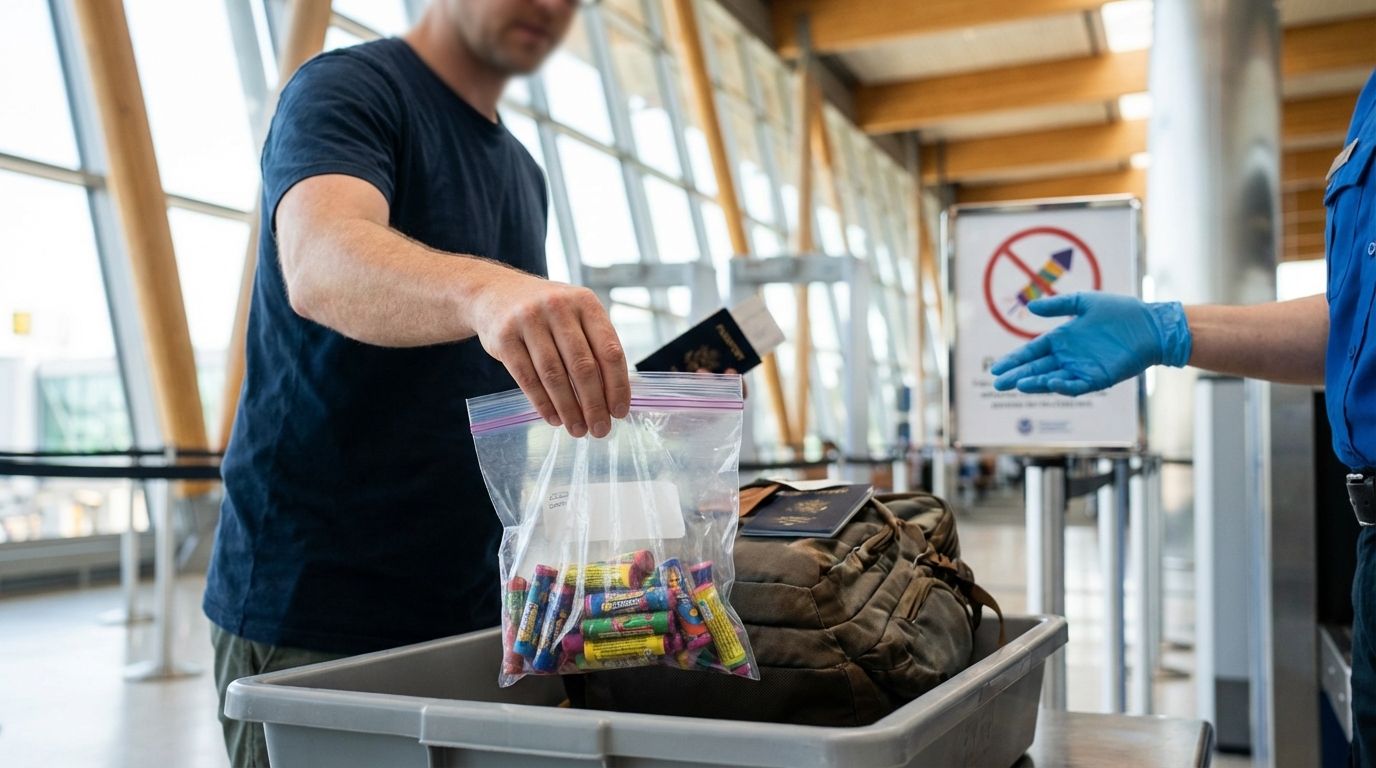
Quick Answer
Fireworks are completely banned on airplanes — no exceptions. Not in carry-on, not in checked bags, not even sparklers. Here's why, and what the penalties look like if you try.
The Short Answer
No. Absolutely not. Fireworks are completely prohibited on airplanes — in carry-on bags, checked luggage, and shipped cargo. This isn't a gray area or a judgment call. It's a hard ban enforced by the TSA, FAA, and the Department of Transportation.
This applies to all types of fireworks: firecrackers, Roman candles, bottle rockets, aerial shells, smoke bombs, and yes, even sparklers.
Why Fireworks Are Banned
Fireworks are classified as hazardous materials — specifically, they're explosives. In the pressurized, enclosed environment of an aircraft cabin or cargo hold, even a small firework igniting accidentally could be catastrophic.
The FAA puts it bluntly: "Fireworks Don't Fly." That's actually the name of their official safety campaign. Here's what makes fireworks dangerous on planes:
- Fire risk: Aircraft cargo holds have fire suppression systems, but fireworks can overwhelm them
- Explosive force: Even small fireworks contain gunpowder, which is an explosive material
- Chain reaction: One firework igniting can set off others nearby, creating an escalating situation
- Altitude pressure: Changes in cabin pressure can affect the stability of pyrotechnic devices
What About Sparklers?
A lot of people assume sparklers are fine because they seem harmless. They're not fine. Sparklers are banned too.
TSA considers sparklers a flammable object, and they contain the same types of combustible materials as other fireworks, just in a different form. Don't try to sneak them through — airport X-ray machines can easily identify them.
What About Novelty Items?
Party poppers, those tiny paper snap-its you throw on the ground, confetti cannons — these are all in the same category. If it pops, sparks, explodes, or uses any kind of pyrotechnic charge, it's not getting on the plane.
If you're unsure whether a specific item qualifies as a firework, use the TSA's "What Can I Bring?" tool on their website or contact them via social media @AskTSA on X (Twitter) or Facebook Messenger. They respond surprisingly fast.
The Penalties Are Severe
This is where it gets serious. Bringing fireworks onto a plane isn't just a minor infraction — it's a federal violation with steep consequences.
Civil Fines (FAA)
- Up to $75,000 per violation for transporting hazardous materials
- Up to $175,000 per violation in cases involving death, serious injury, or substantial property destruction
TSA Penalties
- Civil penalties of up to $17,062 per violation
Criminal Penalties
- Fines and up to 5 years in federal prison for a hazardous materials violation
- Up to 10 years in prison if the violation results in death or bodily injury
And that's before you factor in being banned from the airline, added to a no-fly list, and dealing with the legal costs of defending yourself. It's simply not worth it.
Can You Ship Fireworks Instead?
Not by air. You cannot mail or ship fireworks via any air cargo service. UPS, FedEx, and USPS all prohibit fireworks in air shipments.
Ground shipping of consumer fireworks is possible in some cases, but it comes with its own set of DOT regulations, special packaging requirements, and hazardous materials handling fees. It's legal in certain circumstances but complicated.
The simplest solution? Buy fireworks at your destination. They're widely available in most states during holiday seasons, and many fireworks shops near popular destinations specifically cater to tourists.
What If TSA Finds Fireworks in Your Bag?
Here's what happens if fireworks are discovered during security screening:
- The items are immediately confiscated. You won't get them back.
- You'll be pulled aside for additional screening. Expect a thorough bag search and possibly a pat-down.
- TSA may involve law enforcement. Local police or airport security could be called to the checkpoint.
- You could miss your flight. The screening and investigation process takes time.
- A report is filed. Even if you're allowed to continue traveling (without the fireworks), the incident is documented and could result in follow-up enforcement action.
If you realize you accidentally packed fireworks before reaching the checkpoint, your best move is to throw them away in an airport trash bin, return them to your car, or give them to someone who isn't flying. Do not try to go through security with them.
State Laws Add Another Layer
Keep in mind that fireworks legality varies by state. Even if you could somehow transport fireworks (by driving, for example), possessing certain types is illegal in states like Massachusetts, New Jersey, and parts of New York. You could face state charges on top of any federal penalties.
Alternatives for Celebrations
If you're heading to a destination for a celebration and want some festive flair, consider these plane-friendly alternatives:
- LED light-up toys: Battery-powered sparkle sticks and light wands are allowed
- Glow sticks: Perfectly fine in carry-on and checked bags
- Confetti (non-explosive): Regular paper confetti is allowed — just not confetti cannons or poppers
- Noise makers: Horns and whistles are allowed, though your seatmates won't appreciate a demo
Common Misconceptions About Fireworks and Flying
There are a few myths that keep coming up about fireworks and air travel. Let's clear them up.
"Small Fireworks Are Fine"
No. There's no size exception. A single firecracker is treated the same as a case of Roman candles. The ban applies regardless of quantity or size.
"I Can Wrap Them So They Won't Go Off"
Packaging doesn't matter. Even properly packaged, commercially sealed fireworks are prohibited. The material itself is what's banned, not the risk of accidental ignition during the flight.
"They Won't Find Them in Checked Luggage"
All checked bags are screened by TSA, including being X-rayed and sometimes physically inspected. Pyrotechnic materials have distinct signatures on X-ray machines. TSA officers are trained to identify them, and explosive trace detection equipment can pick up residue even from handled packaging.
"Other Countries Allow It"
Virtually every aviation authority in the world prohibits fireworks on aircraft. ICAO (International Civil Aviation Organization) guidelines classify them as dangerous goods. You won't find a legitimate airline anywhere that allows them.
How TSA Detects Fireworks
TSA uses multiple layers of screening for both carry-on and checked baggage. X-ray machines display explosive materials in specific colors that trained operators recognize immediately. If the X-ray raises a flag, the bag gets pulled for a manual inspection.
In addition, TSA uses explosive trace detection (ETD) swabs at random and when triggered by screening alerts. These swabs detect microscopic residue from gunpowder and other explosive compounds — the same materials found in fireworks.
The bottom line: TSA's detection capabilities are sophisticated enough that trying to hide fireworks is both futile and risky. It's not a matter of if they'll find them — it's when.
July 4th and New Year's Travel
TSA sees a significant spike in fireworks confiscations around July 4th and New Year's Eve. During these holiday periods, screening is often heightened for exactly this reason. If you're flying around a major holiday, be especially careful about what ends up in your bags.
The most common scenario isn't someone intentionally smuggling a case of fireworks. It's a traveler who bought some at a roadside stand earlier in the trip and tossed them in a bag without thinking. That absent-minded packing can lead to a very bad day at the airport — delays, fines, and potentially criminal charges.
Before you pack for your return flight, do a thorough check of every pocket, pouch, and compartment in your luggage. If you bought fireworks during your trip, use them up, give them away, or leave them behind.
Frequently Asked Questions
Frequently Asked Questions
Can you bring sparklers on a plane?
No. Sparklers are classified as flammable objects and are banned from both carry-on and checked luggage. TSA treats them the same as any other firework.
What is the fine for bringing fireworks on a plane?
The FAA can impose civil fines up to $75,000 per violation, and TSA can add penalties up to $17,062. Criminal violations can result in up to 5 years in prison, or 10 years if someone is injured.
Can you put fireworks in checked luggage?
No. Fireworks are banned from checked luggage just as they are from carry-on bags. There is no way to legally transport fireworks on a commercial aircraft.
Can you mail fireworks through USPS or ship them via FedEx by air?
No. Fireworks cannot be shipped by any air cargo service. Ground shipping is possible in limited circumstances with proper DOT hazardous materials handling, but air shipping is completely prohibited.
What should I do if I accidentally packed fireworks before a flight?
Dispose of them before reaching the security checkpoint. You can throw them away, return them to your car, or give them to someone not flying. Do not attempt to go through TSA with fireworks in your bag.
Written by Aviation Experts
Aviation Professionals
With decades of combined experience in the aviation industry, our team shares insider knowledge to make your travel experience smoother and less stressful.
Was this article helpful?