Can You Bring Chargers on a Plane?
Quick Answer
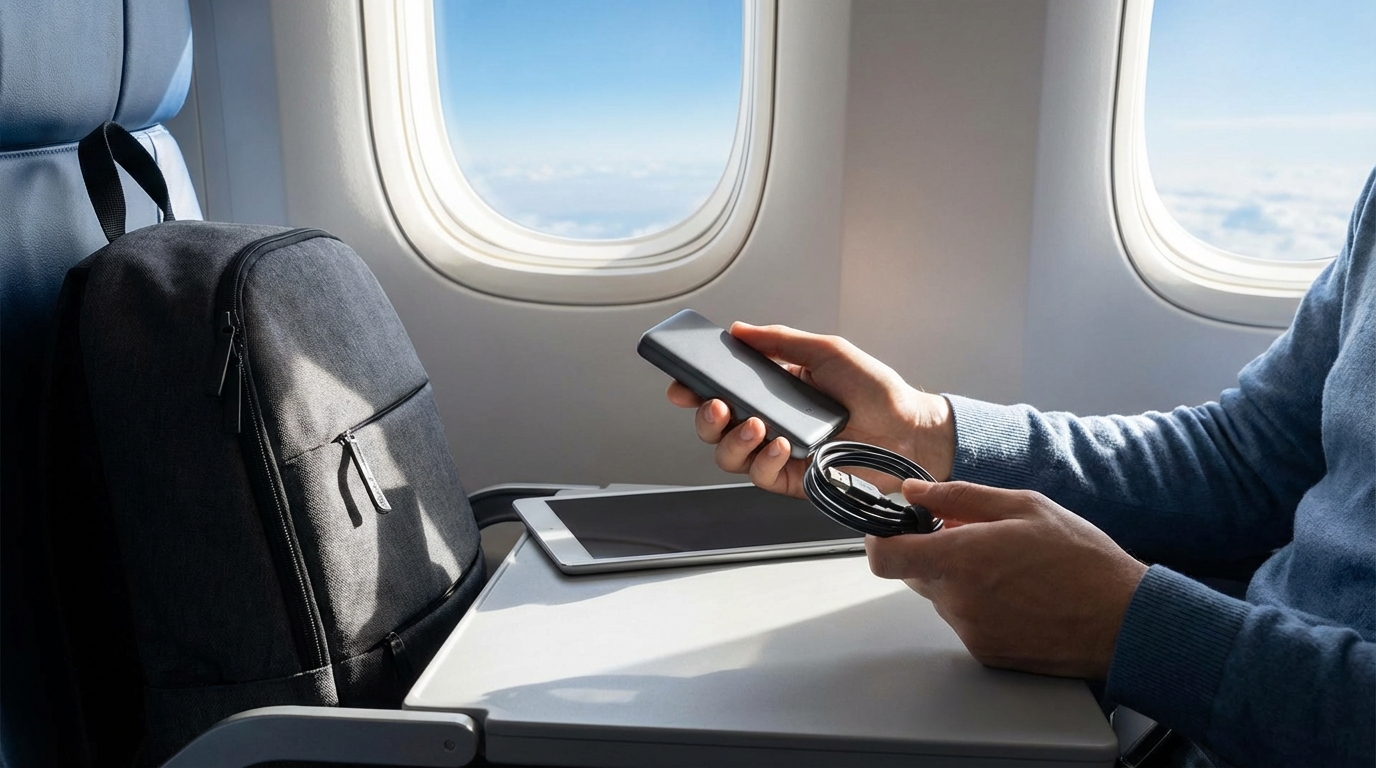
Yes, you can bring chargers on a plane. Phone chargers, laptop chargers, and charging cables are allowed in both carry-on and checked bags. Portable chargers (power banks) with lithium batteries must go in your carry-on only — never in checked luggage.
The Quick Answer
All chargers are allowed on planes. Phone chargers, laptop chargers, USB cables, wireless charging pads, wall adapters — TSA has no problem with any of them. The only rule that matters: if your charger has a built-in lithium battery (like a portable power bank), it must go in your carry-on, not your checked bag.
That's the short version. But chargers come in many forms, and each type has slightly different considerations. Let's go through them all.
Types of Chargers and Their Rules
Phone Chargers (Wall Adapters and Cables)
A standard phone charger — the wall plug and USB cable you got with your phone — has no battery inside. It's just a power adapter and a wire. These are unrestricted:
- Carry-on: yes
- Checked bag: yes
- No security screening issues
- No quantity limits
You don't need to remove a phone charger from your bag at security. It's not an electronic device that requires separate screening.
Laptop Chargers
Same deal as phone chargers. A laptop charger is a power adapter with a cable. No battery, no restrictions. Pack it in your carry-on or checked bag — wherever it fits.
Some laptop chargers are bulky (looking at you, gaming laptop bricks), but size doesn't matter to TSA. They're allowed regardless. Just be aware that heavy chargers eat into your carry-on weight allowance if your airline enforces weight limits.
Portable Chargers / Power Banks
This is where the rules get specific. Portable chargers contain lithium-ion batteries, and the FAA regulates lithium batteries on aircraft.
The key rules:
- Carry-on only — power banks must be in your carry-on bag. They are banned from checked luggage. This is an FAA safety rule, not optional.
- Under 100 Wh — allowed without airline approval. Most consumer power banks fall here.
- 100-160 Wh — allowed with airline approval, limited to two per person
- Over 160 Wh — banned from passenger aircraft entirely
We'll go deeper on power banks in the sections below, since they're the most common source of confusion.
Wireless Chargers
Wireless charging pads (like Qi chargers for iPhones or Samsung devices) are simple electronics with no battery. They're allowed in carry-on and checked bags with no restrictions. They don't need to be removed from your bag at security.
Multi-Port Charging Stations
Travel charging stations with multiple USB ports are fine in carry-on and checked bags. These are just power adapters — no batteries, no issues.
Solar Chargers
Solar panels themselves are allowed. If the solar charger has a built-in battery (many do), it follows the same rules as a power bank — carry-on only, and the battery must be under 100 Wh.
Understanding Watt-Hours
Since watt-hours (Wh) determine whether your charger is allowed, you need to know how to figure out your device's rating.
Finding the Wh Rating
Many power banks print the Wh rating directly on the label. If yours only shows milliamp-hours (mAh), here's the conversion:
Wh = (mAh / 1000) x Voltage
Most power banks use 3.7V internally, so:
- 10,000 mAh = 37 Wh (well under limit)
- 20,000 mAh = 74 Wh (under limit)
- 26,800 mAh = 99.16 Wh (just under limit)
- 30,000 mAh = 111 Wh (needs airline approval)
The 100 Wh threshold roughly translates to about 27,000 mAh at 3.7V. If your power bank is 26,800 mAh or less, you're almost certainly fine.
What If There's No Label?
If your power bank doesn't have a visible Wh or mAh rating, TSA officers may not let it through. They can't verify it meets the limit without a label. Always travel with chargers that have their specs clearly printed on the device.
Security Screening for Chargers
Most chargers don't cause any issues at TSA checkpoints, but here's what to expect.
What to Remove From Your Bag
TSA requires electronics larger than a cell phone to be removed for X-ray screening. Most chargers don't meet this threshold:
- Phone chargers and cables — stay in bag
- Laptop chargers — stay in bag (they're accessories, not standalone electronics)
- Small power banks — can usually stay in bag, though pulling them out preemptively can prevent a bag check
- Large power banks — consider pulling these out. A dense brick of lithium battery can look suspicious on an X-ray
In TSA PreCheck lanes, nothing needs to come out. Same for airports with CT scanners.
Why Chargers Sometimes Get Flagged
Power banks are dense rectangular objects that show up prominently on X-rays. If a TSA officer can't identify what the dense block in your bag is, they'll pull the bag for a manual check. This isn't because chargers are prohibited — they just need to verify what the object is.
To speed things up: put your power bank in an easily accessible pocket of your bag. When the bag gets flagged, you can quickly show the officer what it is.
Charging Your Devices During the Flight
Having the right charger setup makes a big difference on long flights.
In-Seat Power Options
Modern aircraft increasingly offer charging at every seat, but the type varies:
- USB-A ports — the most common. Charge phones and tablets at standard speed.
- USB-C ports — newer aircraft are adding these. Faster charging, and they can charge some laptops.
- AC power outlets — full 110V outlets, usually in business/first class but increasingly in economy. Plug in your laptop charger and work all flight.
- EmPower ports — older aircraft have these proprietary ports. You'll need a special adapter.
Not every seat has power. Budget carriers and older aircraft may have no charging at all. Check your airline and aircraft type before you fly if charging matters to you.
Portable Charger Strategy
If you're not sure about in-seat power, bring a portable charger as backup. A 10,000 mAh power bank weighs about half a pound and can fully charge most phones twice. That's plenty for a domestic flight.
For international flights or heavy use, a 20,000 mAh power bank gives you four to five phone charges. Still well under the 100 Wh limit.
Charging Multiple Devices
If you're traveling with a phone, tablet, headphones, and a smartwatch, a multi-port charger is your friend. Bring a wall adapter with at least two USB ports for gate charging before your flight, and a small power bank for the air.
International Travel Charger Tips
Different countries use different electrical outlets and voltages. If you're flying internationally, you'll need to consider:
- Plug adapters — a simple physical adapter that lets your US plug fit into a foreign outlet. Allowed in carry-on and checked bags without restriction.
- Voltage converters — converts between 110V and 220V. Most modern phone and laptop chargers are dual-voltage (check the fine print: it should say "100-240V"), so you usually only need a plug adapter, not a converter.
- Universal travel adapters — combination adapters that work in multiple countries. Many have built-in USB ports. These are allowed in carry-on and checked bags.
Gate Check Situations
If you're forced to gate-check your carry-on bag (common on small regional jets), you need to remove any power banks or portable chargers before handing the bag over. Gate-checked bags go into the cargo hold, where lithium batteries aren't allowed.
Flight attendants or gate agents should remind you, but don't count on it. Make a habit of keeping your portable charger in your personal item (purse, backpack, or laptop bag) rather than your carry-on suitcase, so you're never caught scrambling at the gate.
Quick Reference Guide
- Phone charger (wall adapter + cable) — carry-on or checked bag, no restrictions
- Laptop charger — carry-on or checked bag, no restrictions
- USB cable — carry-on or checked bag, no restrictions
- Wireless charging pad — carry-on or checked bag, no restrictions
- Portable charger under 100 Wh — carry-on only
- Portable charger 100-160 Wh — carry-on only, airline approval needed
- Portable charger over 160 Wh — not allowed on plane
Frequently Asked Questions
Can you bring a phone charger on a plane?
Yes. Phone chargers (wall adapters and USB cables) are allowed in both carry-on and checked bags with no restrictions. They don't contain batteries, so there are no special rules.
Can portable chargers go in checked luggage?
No. Portable chargers and power banks contain lithium-ion batteries and must go in your carry-on bag. The FAA bans spare lithium batteries from checked luggage because battery fires in the cargo hold are harder to detect and fight.
What size portable charger is allowed on a plane?
Power banks under 100 watt-hours (Wh) are allowed without restriction. That's roughly 27,000 mAh at 3.7V. Power banks between 100-160 Wh need airline approval. Anything over 160 Wh is banned from passenger aircraft.
Do you have to take chargers out of your bag at TSA?
Standard phone and laptop chargers can stay in your bag. Large power banks may be pulled for additional screening. In TSA PreCheck or CT scanner lanes, nothing needs to come out.
What happens if you put a portable charger in checked luggage?
Airport baggage screening may catch it and remove it from your bag — you likely won't get it back. If it makes it through, you've violated FAA safety rules. Fines for lithium battery violations can reach over $17,000 per incident.
Written by Aviation Experts
Aviation Professionals
With decades of combined experience in the aviation industry, our team shares insider knowledge to make your travel experience smoother and less stressful.
Was this article helpful?