Can You Bring Frozen Water Through Airport Security?
Quick Answer
Yes, you can bring frozen water through airport security as long as it's completely frozen solid at the time of screening. If there's any liquid water in the container, it falls under the 3-1-1 liquids rule and won't be allowed.
Frozen Water Is Allowed Through TSA
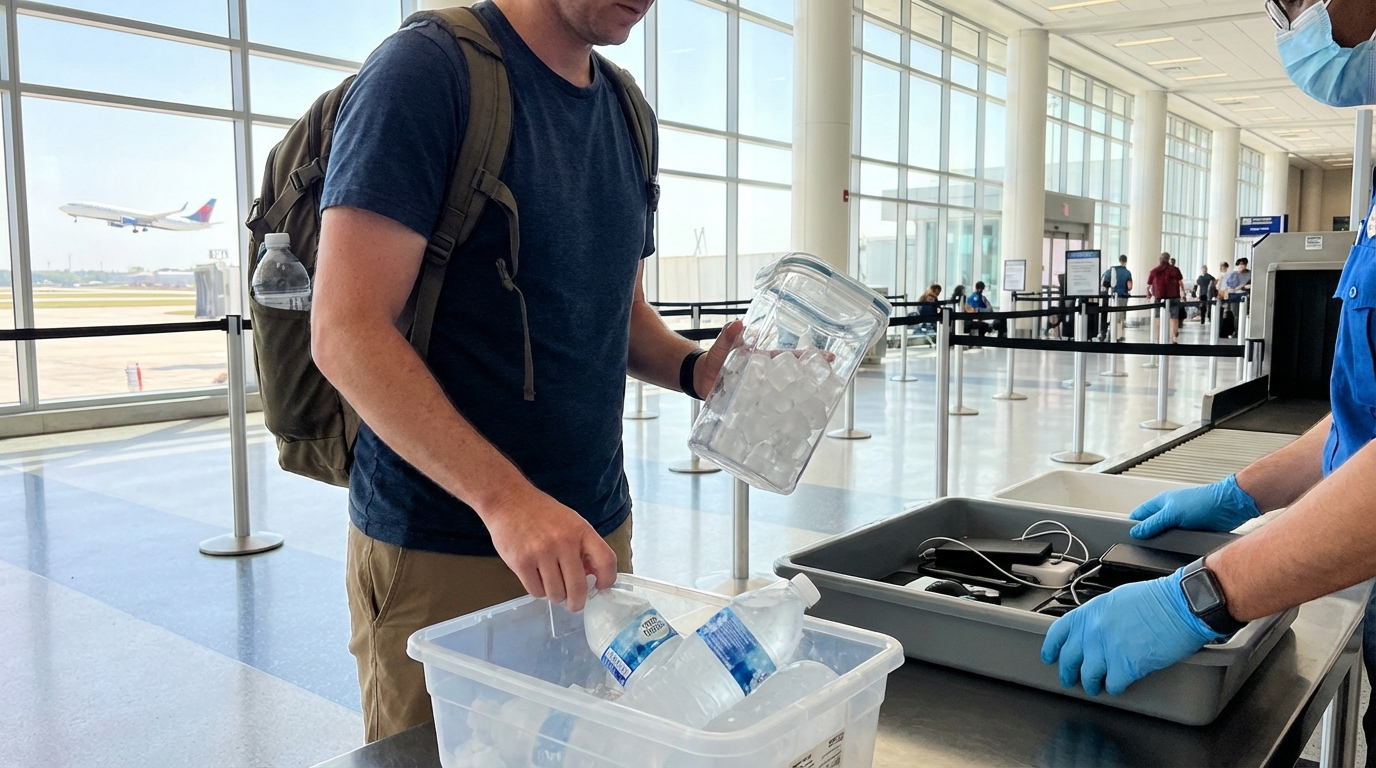
Here's a TSA rule that surprises most people: you can bring frozen water through airport security. The TSA considers ice a solid, not a liquid, so it doesn't fall under the 3-1-1 liquids rule. You can bring a completely frozen water bottle right through the checkpoint.
But there's one critical requirement: the water must be 100% frozen solid when it goes through the X-ray machine. Not mostly frozen. Not slushy. Not frozen with a little pool of liquid at the bottom. Completely, entirely, solid ice.
If the TSA officer picks up your bottle and hears any sloshing, or sees any liquid on the X-ray, it gets treated as a liquid. That means it either needs to be 3.4 ounces or less, or it gets tossed.
How to Actually Pull This Off
Getting a frozen water bottle through security sounds simple, but the logistics matter. Ice melts. Here's how to make it work:
The Night Before
- Fill your water bottle about 80-90% full (water expands when it freezes, so leave room).
- Use a rigid bottle, not a thin plastic one that might crack when the ice expands.
- Place the bottle upright in your freezer the night before your flight. It needs at least 8-10 hours to freeze solid.
- Don't use an insulated bottle for freezing – they take forever to freeze. Use a standard hard plastic bottle, then transfer to an insulated carrier if you want.
Morning of Your Flight
- Pull the bottle from the freezer right before you leave for the airport.
- Wrap it in a small towel or place it in an insulated lunch bag to slow the melting.
- Keep it in the coldest spot in your bag during your commute to the airport.
At the Checkpoint
- Place the frozen bottle in a bin by itself so the TSA officer can see it clearly on the X-ray.
- If the officer has any questions, explain that it's frozen solid. They may pick it up to verify.
- If it's started to melt and there's liquid present, you'll need to dump the liquid portion. The remaining ice will still be allowed through.
When This Strategy Works Best
The frozen water trick works best under specific conditions:
- Early morning flights – You can pull the bottle from the freezer and be through security before any significant melting happens.
- Short commutes to the airport – If you live 15 minutes from the airport, you're golden. If it's a 90-minute drive in summer, that ice is going to be in trouble.
- Winter travel – Cold outdoor temps work in your favor. Your bottle stays frozen longer.
- Quick security lines – TSA PreCheck or a short line means less time for melting.
This strategy is trickiest during summer, with long airport commutes, or when you're facing a lengthy security line. By the time you reach the X-ray, your "frozen" water might be half melted.
What About Frozen Drinks Other Than Water?
The frozen rule applies to any frozen liquid, not just water. You could theoretically bring frozen juice, frozen coffee, or frozen smoothies through security. As long as it's completely solid, it's allowed.
In practice, sugary drinks have a lower freezing point than water, so they may not freeze as solidly or they may melt faster. Stick with water for the most reliable results.
Ice Packs and Gel Packs
This is related and worth knowing: ice packs and gel packs follow the same rule. If they're frozen solid, they can go through security. If they're partially melted or squishy, they're treated as a gel and must comply with 3-1-1.
This matters if you're traveling with:
- Breast milk or formula that needs to stay cold
- Medication that requires refrigeration
- Perishable food items
For medically necessary items like breast milk or temperature-sensitive medication, there's an exemption: you can bring ice packs in any state (frozen, partially melted, or fully melted) to keep these items cold. Just declare them to the TSA officer.
Why Would You Even Bother?
Fair question. When you could just bring an empty bottle and fill it after security, why go through the hassle of freezing water?
There are a few legit reasons:
- You want ice-cold water for hours. A frozen bottle acts as its own ice. As it slowly melts during your flight, you've got perfectly cold water for the entire trip. No lukewarm water from the drinking fountain.
- You're packing a cooler for food. Frozen water bottles double as ice packs for perishable food in your carry-on.
- You're an athlete or outdoor traveler. If you're heading somewhere hot and need cold water the moment you land, starting with a frozen bottle gives you a head start.
- You just like the challenge. Some frequent travelers treat TSA rules like a game. Technically allowed? Let's do it.
What If It Partially Melts Before Security?
If your frozen water has started to melt by the time you reach the checkpoint, you have options:
- Pour out the liquid. Dump the melted water into a trash can or sink near security. The remaining ice block is still a solid and will be allowed through.
- Drink the liquid portion. Sip out the melted water and present just the ice.
- Accept the loss. If it's mostly melted, just empty the whole thing and fill up after security. No big deal.
The TSA officer won't penalize you for trying. Worst case, you pour out some water.
Does This Work at All Airports?
The frozen liquid rule is an official TSA policy, so it applies at all US airports. However, individual TSA officers may not be familiar with this specific rule. It's not one that comes up every day.
If an officer questions your frozen bottle, politely mention that TSA policy allows frozen solids through the checkpoint. You can even pull up the TSA's website on your phone, which confirms the rule. Most officers will verify and let it through.
For international airports, the rule varies by country. Many countries follow similar guidelines, but don't assume. If you're departing from a non-US airport, check that country's aviation security rules first.
Pro Tips
- Freeze two bottles: one for drinking, one as an ice pack for food.
- A wide-mouth bottle freezes and thaws more predictably than a narrow-neck one.
- If you're checking a bag, you can throw frozen bottles in there with no restrictions at all.
- Don't freeze a glass bottle. Expanding ice can crack glass.
- Stainless steel bottles work fine for freezing but take longer to freeze solid than plastic.
Frequently Asked Questions
What happens if my frozen water bottle starts melting at TSA?
If there's any liquid water in the bottle, the TSA will treat it as a liquid. You can pour out the melted portion and keep the remaining ice, or dump it all and fill up after security. You won't get in trouble either way.
Can I bring a frozen smoothie through TSA?
Yes, as long as it's completely frozen solid. But be aware that smoothies and sugary drinks have a lower freezing point than water, so they may melt faster or not freeze as solidly. Water is the most reliable option for the frozen liquid strategy.
Do frozen ice packs count as liquids at TSA?
Frozen solid ice packs are treated as solids and are allowed through security. If they're partially melted, squishy, or have liquid inside, they count as a gel and must follow the 3-1-1 rule. Exception: ice packs for medically necessary items like breast milk are allowed in any state.
Written by Aviation Experts
Aviation Professionals
With decades of combined experience in the aviation industry, our team shares insider knowledge to make your travel experience smoother and less stressful.
Was this article helpful?