Can You Bring A Flashlight On A Plane?
Quick Answer
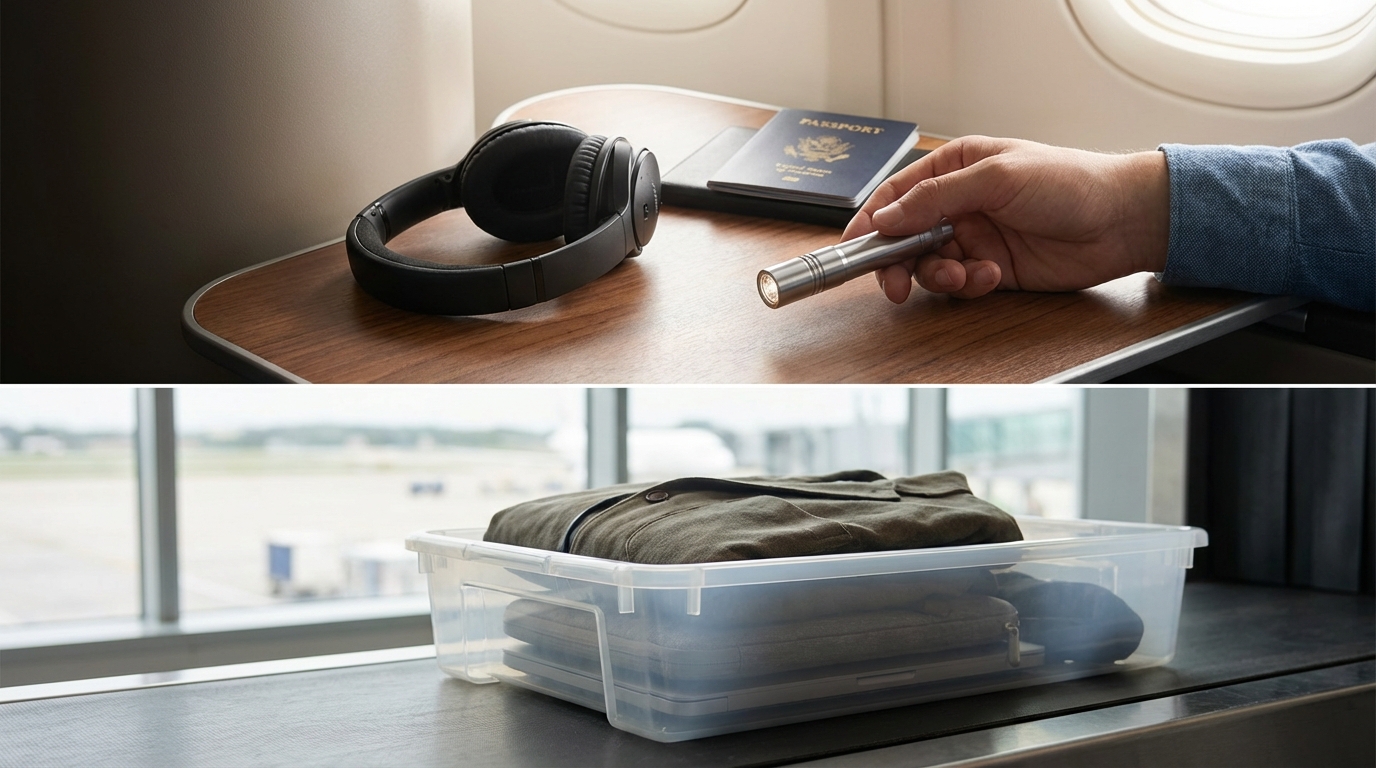
Yes, you can bring a flashlight on a plane. TSA allows flashlights in both carry-on and checked luggage with no special restrictions for standard models, though very large tactical flashlights may get a second look.
Flashlights Are Allowed on Planes
You can bring a flashlight on a plane in your carry-on bag or checked luggage. The TSA has no problem with standard flashlights - LED, incandescent, headlamps, keychain lights, or even those chunky Maglites your dad keeps in the garage.
There's no need to declare it, remove it from your bag at security, or do anything special. It'll go through the X-ray like everything else in your bag, and you'll be on your way.
The One Exception: Size Matters
Here's where it gets slightly nuanced. The TSA doesn't have a specific rule banning large flashlights, but they do have a general policy about items that could be used as bludgeoning weapons. If your flashlight is long and heavy enough to double as a club, a TSA agent has the discretion to flag it.
In practice, this means:
- Small to medium flashlights (under 7 inches): No issues whatsoever. This covers the vast majority of everyday carry flashlights, headlamps, and pocket lights.
- Standard Maglites (2-3 D-cell, around 10-12 inches): Usually fine, but you might get a question. Most agents won't blink.
- Large Maglites (4-6 D-cell, 15-20 inches): This is where you could run into trouble. A 20-inch metal flashlight looks a lot like a baton, and TSA agents have flagged them before. Pack these in checked luggage to be safe.
The general rule of thumb: if it's longer than your forearm and made of solid metal, check it.
Tactical Flashlights: The Gray Area
Tactical flashlights are extremely popular with travelers, and for good reason - they're compact, bright, and useful in all kinds of situations. Most tactical flashlights are perfectly fine in carry-on bags.
But some tactical flashlights come with features that complicate things:
Strike bezels (crenulated bezels): Those aggressive-looking toothed edges around the lens? TSA agents sometimes flag these. The bezel is designed as a self-defense feature, and some agents treat it like a weapon. If your tactical light has a pronounced strike bezel, there's a chance it gets confiscated. It's agent-dependent, which is the frustrating part.
Built-in knives or tools: If your flashlight has an integrated blade, box cutter, or glass breaker spike, that feature is what'll get it pulled. Blades over 2.36 inches aren't allowed in carry-on at all.
Stun gun flashlights: Hard no. Stun guns are prohibited in carry-on bags regardless of what they look like. Stun gun flashlights must go in checked luggage, and even then, the stun function must be disabled and the device must be secured against accidental activation.
A standard tactical flashlight like a SureFire, Streamlight, Fenix, or Olight? You'll be fine. The strobe mode, high lumen output, and aluminum body aren't issues.
Battery Rules You Need to Know
The flashlight itself isn't the issue for most travelers - it's the batteries. This is where TSA and FAA rules overlap, and it's worth understanding.
Standard Batteries (AA, AAA, C, D)
No restrictions at all. Alkaline and NiMH batteries in standard sizes can go in carry-on or checked bags. Keep them in the flashlight or in their original packaging - that's all you need to do.
Lithium Batteries (CR123A, 18650, 21700)
This is where most tactical and high-performance flashlights get their power, and lithium batteries have specific rules:
- Installed in your flashlight: Allowed in carry-on and checked bags. No issues.
- Spare lithium batteries: Carry-on only. You cannot pack spare lithium batteries in checked luggage. This is an FAA safety rule, not a TSA whim.
- Watt-hour limits: Lithium-ion batteries under 100 Wh are fine without airline approval. Between 100-160 Wh, you need airline approval (but standard flashlight batteries are nowhere near this - an 18650 is typically around 10-13 Wh).
The practical takeaway: keep your spare 18650s and CR123As in your carry-on bag, ideally in a battery case to prevent short circuits. A loose lithium battery rattling around with coins and keys is a fire hazard - and exactly the kind of thing that gets flagged.
Rechargeable Flashlights with Built-In Batteries
Flashlights with integrated rechargeable batteries (like many Olight and Nitecore models with USB-C charging) follow the same rules as any lithium battery device. They're fine in carry-on and checked bags. Just make sure the light is locked out or turned off so it doesn't activate in your bag.
Headlamps: Same Rules Apply
Headlamps are flashlights. TSA treats them identically. Whether you're bringing a Petzl, Black Diamond, or BioLite headlamp for hiking, camping, or travel, it's allowed in carry-on and checked bags without any hassle.
Headlamps actually tend to sail through security even more smoothly than handheld flashlights because they're clearly recreational gear. No agent has ever mistaken a 3-oz headlamp for a weapon.
One tip for headlamp travelers: lock out the battery or remove it before packing. The button on most headlamps is easy to press accidentally, and you don't want to land with a dead battery because your headlamp was on for six hours in your bag.
How Many Flashlights Can You Bring?
There's no limit on the number of flashlights you can bring. If you're a flashlight enthusiast (and yes, r/flashlight has over 250,000 members), you can pack your entire collection as long as everything fits within your baggage allowance.
The only practical limitation is spare lithium batteries. The FAA doesn't set a hard number for batteries under 100 Wh, but they do say a "reasonable quantity for personal use." Bringing 2-4 spare 18650s won't raise an eyebrow. Bringing 50 might invite questions.
International Travel with Flashlights
Flashlight rules are remarkably consistent worldwide. Security agencies in Europe, Asia, Australia, and most other regions follow similar guidelines to the TSA. A standard flashlight in your carry-on bag won't be an issue at Heathrow, Narita, or Sydney airports.
A few things to keep in mind for international travel:
Strike bezels are more likely to be flagged in some countries. UK security, in particular, tends to be stricter about anything that could be classified as a self-defense tool. If you're transiting through London, skip the tactical bezel.
Lithium battery rules are universal. IATA (the International Air Transport Association) sets the global standard, and virtually every airline follows it. Spare lithium batteries go in carry-on, not checked bags - this is true everywhere.
High-powered lasers built into flashlights may be restricted or illegal in some countries. Australia, for example, bans laser pointers over 1 mW without a permit. If your flashlight has a built-in laser, check your destination's laws.
Best Flashlights for Air Travel
If you're shopping for a travel-friendly flashlight, here's what to look for:
- Compact size: Under 5 inches means zero hassle at security and easy packing.
- USB-C rechargeable: You can top off on the plane or at the airport without carrying spare batteries.
- Lockout mode: Prevents the light from turning on accidentally in your bag.
- Smooth bezel: Avoids any potential issues with overzealous TSA agents.
- Multiple brightness levels: A low mode for reading in your seat, a high mode for wherever you're headed.
Popular travel-friendly options include the Olight Baton series, Fenix E-series, and Nitecore TINI. All are compact, rechargeable, and completely hassle-free at security.
What to Do If TSA Flags Your Flashlight
If an agent pulls your flashlight, stay calm. In most cases, they just want a closer look - metal objects can be hard to identify on the X-ray, especially if they're packed next to other dense items.
If an agent wants to confiscate your flashlight (usually only for large or strike-bezel models), you have a few options:
- Check it: If you have time before your flight, you can go back to the check-in counter and put it in a checked bag.
- Mail it home: Some airports have shipping services near security where you can mail prohibited items to yourself.
- Surrender it: If it's a $10 gas station flashlight, it's probably not worth the hassle. If it's a $200 SureFire, explore the other options first.
For the record, flashlight confiscations are rare. The TSA processes millions of passengers daily, and the vast majority of flashlights go through without a second glance.
Frequently Asked Questions
Can you bring a Maglite on a plane?
Small and medium Maglites (2-3 cell) are generally fine in carry-on bags. Large Maglites (4+ cells, 15 inches or longer) might get flagged as a potential bludgeoning tool - pack those in checked luggage to avoid any issues.
Are tactical flashlights allowed through TSA?
Standard tactical flashlights from brands like SureFire, Streamlight, and Fenix are allowed in carry-on bags. The exception is models with aggressive strike bezels, which some TSA agents flag, and any flashlight with a built-in stun gun, which is prohibited in the cabin.
Can you pack spare flashlight batteries in checked luggage?
Standard alkaline batteries (AA, AAA, C, D) can go in checked bags. Spare lithium batteries (CR123A, 18650, 21700) must go in your carry-on bag - this is an FAA safety rule that applies to all flights.
Written by Aviation Experts
Aviation Professionals
With decades of combined experience in the aviation industry, our team shares insider knowledge to make your travel experience smoother and less stressful.
Was this article helpful?