Can You Carry Cigarettes on a Plane?
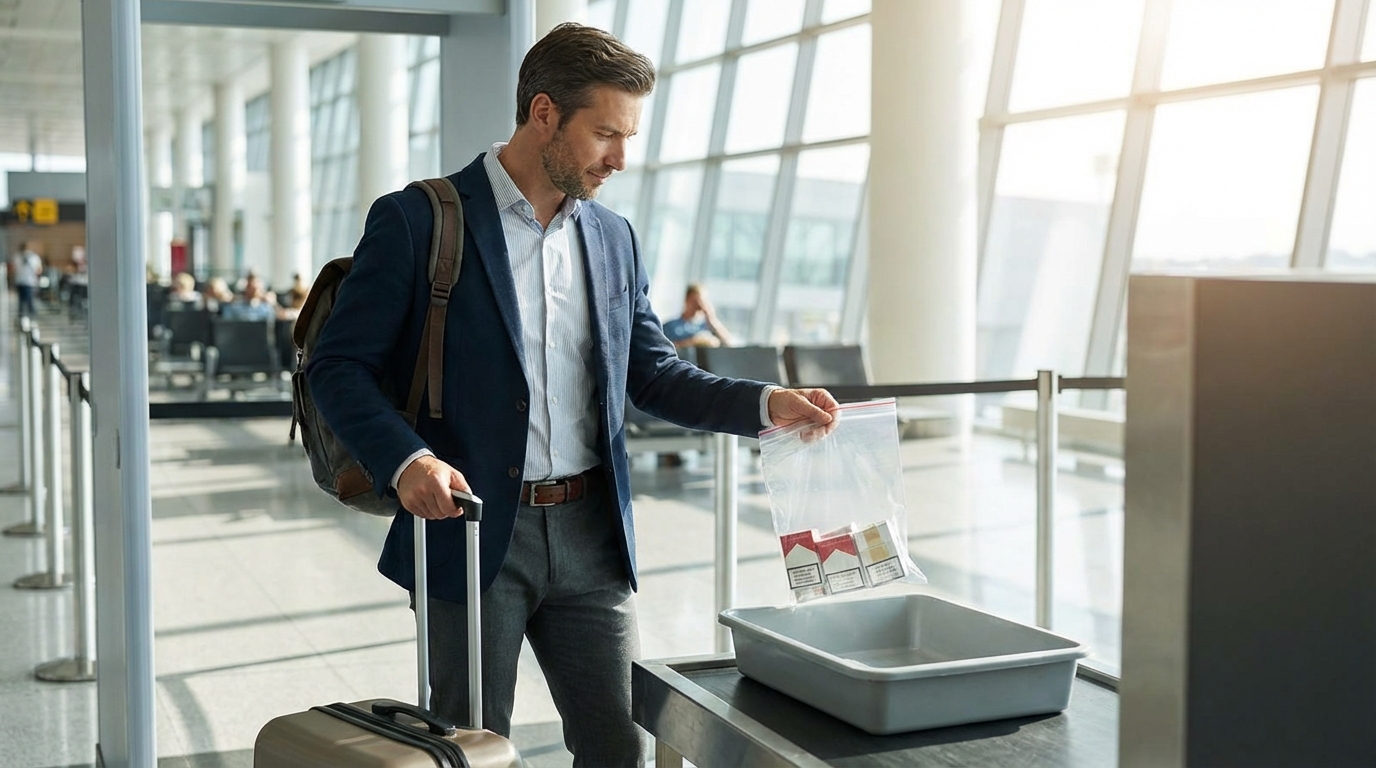
Quick Answer
Yes, you can carry cigarettes on a plane in both carry-on and checked bags. TSA has no restrictions on standard cigarettes. Here's what you need to know about lighters, international customs limits, and e-cigarettes.
The Quick Answer
Cigarettes are allowed on planes. You can pack them in your carry-on bag, checked luggage, or even your pocket. TSA doesn't restrict standard tobacco cigarettes in any way — no quantity limits for domestic flights, no special screening procedures, no declaration required.
Where it gets complicated is everything around cigarettes: lighters, matches, e-cigarettes, international customs limits, and the obvious fact that you can't smoke them on the plane.
Cigarettes in Carry-On Bags
Pack cigarettes anywhere in your carry-on. They don't need to come out during screening, they don't go in your liquids bag, and TSA won't give them a second look on the X-ray. A single pack, a full carton, or even multiple cartons — all fine for domestic U.S. flights.
Cigarettes show up clearly on X-ray machines and aren't going to trigger any additional screening. They're one of the most straightforward items to fly with.
Cigarettes in Checked Bags
Also completely fine. You can pack cigarettes in your checked luggage without any restrictions from TSA. The only reason you might prefer carry-on is if you want to smoke during a layover (more on that below).
Lighters and Matches
This is where most smokers run into trouble. The rules around lighters are more restrictive than the rules around cigarettes themselves.
Carry-On
- Disposable lighters (like a Bic) — allowed, one per person
- Zippo-style lighters — allowed, one per person
- Safety matches — one book of safety matches per person, must be on your person or in carry-on
- Torch lighters (jet flame/blue flame) — not allowed in carry-on or checked bags
- Lighter fluid — not allowed in carry-on or checked bags
Checked Bags
- Disposable lighters — not allowed unless in a DOT-approved case
- Zippo lighters — not allowed unless empty (no fuel) or in a DOT-approved case
- Matches — not allowed (strike-anywhere or safety)
The key takeaway: keep your lighter and matches in your carry-on or on your person. Don't pack them in checked bags. And leave torch lighters at home entirely — they're banned everywhere on the plane.
E-Cigarettes and Vapes
Electronic cigarettes, vapes, and vaping devices have completely different rules from traditional cigarettes, and they're stricter.
- Carry-on only. E-cigarettes and vaping devices must go in your carry-on bag. They are not allowed in checked luggage — period. This is because of the lithium batteries inside, which pose a fire risk in the cargo hold.
- Vape juice and e-liquids follow the 3-1-1 rule: containers must be 3.4 oz or smaller and fit in your quart-sized liquids bag.
- Charging on the plane is not allowed on most airlines.
- Using them on the plane is prohibited on all U.S. airlines.
This is non-negotiable. If TSA finds a vape device in your checked bag, they'll pull the bag and may confiscate the device.
Other Tobacco Products
The same carry-on and checked bag rules that apply to cigarettes also apply to:
- Cigars — allowed in carry-on and checked bags
- Pipe tobacco — allowed in both
- Chewing tobacco and snuff — allowed in both
- Nicotine pouches (like Zyn) — allowed in both
- Hookah tobacco — allowed in both (the hookah itself is allowed too, though it may get a second look at screening)
Cigar cutters deserve a mention: TSA allows them in carry-on bags. They used to be restricted but the policy changed. Still, individual TSA officers sometimes flag them, so pack one you wouldn't mind losing if there's a disagreement at the checkpoint.
Smoking During Layovers
You can't smoke on any U.S. airline flight. That's been federal law since the late 1990s, and it applies to all tobacco products, e-cigarettes, and vapes.
During layovers, your options depend on the airport:
- Outdoor smoking areas: Some airports have designated smoking areas outside the terminal. You'll need to exit security, smoke, and go back through TSA — so only do this if you have plenty of time.
- Indoor smoking lounges: A handful of U.S. airports still have enclosed smoking lounges past security. These are becoming rare. Atlanta (ATL), Las Vegas (LAS), and Dallas/Fort Worth (DFW) are among the airports that still have them, but check current availability before counting on it.
- International airports: Many international airports have smoking rooms past security. Asian and Middle Eastern airports tend to be more accommodating than European ones.
International Flights: Customs Limits
Domestic flights within the U.S. have no cigarette quantity limits. International travel is a different story. Customs authorities at your destination (and when you return) set limits on how much tobacco you can bring in duty-free.
Returning to the U.S.
- 200 cigarettes (one carton) per person, duty-free
- 100 cigars per person, duty-free
- You can bring more, but you'll pay duty on the excess
- You must be 21 or older
- Cigarettes manufactured in the U.S. for export and bought abroad cannot be brought back
Common International Limits
- EU countries: 200 cigarettes from outside the EU
- UK: 200 cigarettes
- Canada: 200 cigarettes per person
- Australia: 25 cigarettes (one of the strictest limits)
- Japan: 200 cigarettes for non-residents
- Mexico: 200 cigarettes
Australia's limit catches a lot of travelers off guard — it's just 25 cigarettes, barely more than one pack. Anything over that gets taxed heavily. Always check the customs rules for your destination before packing multiple cartons.
Duty-Free Cigarettes
You can buy cigarettes at duty-free shops in international terminals after clearing security. These purchases are typically cheaper than retail because they're tax-free. But you still need to comply with the customs limits at your destination.
Buying five cartons at duty-free doesn't mean you can bring five cartons into the next country. You'll still owe duty on anything over the limit when you land.
Can Airlines Refuse You for Carrying Cigarettes?
No. Airlines can't refuse to let you board because you're carrying cigarettes. They're a legal product, and TSA has cleared them. The airline's rule is simply that you can't use them on the aircraft.
Some airlines in certain countries may have additional policies about tobacco in cabin baggage, but this is extremely rare for U.S. carriers.
Tips for Smokers Flying
- Keep your lighter in your carry-on — not your checked bag
- Leave torch lighters at home — they're banned entirely
- Vapes go in carry-on only — never checked bags
- Check customs limits before international trips — especially for Australia (25 cigarettes)
- Research layover airports — find out if smoking areas are before or after security
- Bring nicotine gum or patches for long flights — practical alternative when you can't smoke
- Pack cigarettes in a hard case — soft packs get crushed in luggage
State and Local Laws
TSA handles what you can bring through security. But state and local laws govern possession, purchase age, and taxes on tobacco products. A few things to keep in mind:
- Purchase age: Federal law requires you to be 21 to buy tobacco products anywhere in the U.S. This includes cigarettes, cigars, vapes, and all tobacco products.
- State taxes: Cigarette prices vary wildly by state because of different tax rates. A pack that costs $7 in Virginia might cost $14 in New York. Buying cartons in low-tax states and flying them home is legal for personal use, but some states have limits on how many cartons you can transport — New York, for example, restricts it to two cartons.
- Flavored tobacco bans: Some states and cities ban flavored tobacco products, including menthol cigarettes. If you're flying to a jurisdiction with a ban, you technically can't possess those products there, even if you bought them elsewhere.
Packing Tips for Cigarettes
Cigarettes aren't fragile electronics, but a little care goes a long way:
- Use a hard cigarette case for packs in your carry-on or pocket. Soft packs get crushed easily, especially in an overhead bin.
- Cartons go in the center of your bag — surrounded by clothes for cushioning if checked.
- Keep them dry. Cargo holds can have condensation. A zip-lock bag around your carton prevents moisture damage.
- Don't put them next to anything fragrant. Cigarettes absorb odors from perfume, cologne, or scented lotions packed nearby.
What Happens If You Smoke on the Plane
Don't. Smoking on a U.S. airline flight is a federal offense. The consequences are real:
- Fines up to $25,000 from the FAA
- Potential criminal charges
- Being banned from the airline
- Flight diversion, where you'll also face costs for the diversion and possible arrest upon landing
This applies to regular cigarettes, e-cigarettes, vapes, and any smoking device. The smoke detectors in airplane lavatories are extremely sensitive and tamper-proof. Disabling one is another federal offense. It's not worth it.
Frequently Asked Questions
How many cigarettes can you bring on a domestic flight?
There's no limit. TSA doesn't restrict the quantity of cigarettes you can carry on domestic U.S. flights, whether in carry-on or checked luggage. You can bring one pack or ten cartons.
Can you bring a lighter on a plane?
Yes, but only in your carry-on — one disposable or Zippo-style lighter per person. Torch lighters (jet flame) are banned from both carry-on and checked bags. Lighters are not allowed in checked luggage unless they're in a DOT-approved case.
Can you put e-cigarettes in checked luggage?
No. E-cigarettes and vaping devices must be carried in your carry-on bag due to the lithium battery fire risk. This is an FAA regulation and applies to all airlines. Vape juice must follow the 3-1-1 liquids rule (3.4 oz or less per container).
How many cigarettes can you bring into the U.S. from another country?
You can bring 200 cigarettes (one carton) per person duty-free when returning to the U.S. You can bring more than 200, but you'll need to declare the excess and pay customs duty on it. You must be 21 or older.
Can you smoke cigarettes on a plane?
No. Smoking has been banned on all U.S. airline flights since the late 1990s. This includes cigarettes, cigars, pipes, e-cigarettes, and vapes. Violating this ban can result in fines up to $25,000.
Written by Aviation Experts
Aviation Professionals
With decades of combined experience in the aviation industry, our team shares insider knowledge to make your travel experience smoother and less stressful.
Was this article helpful?