Can You Bring Vitamins on a Plane?
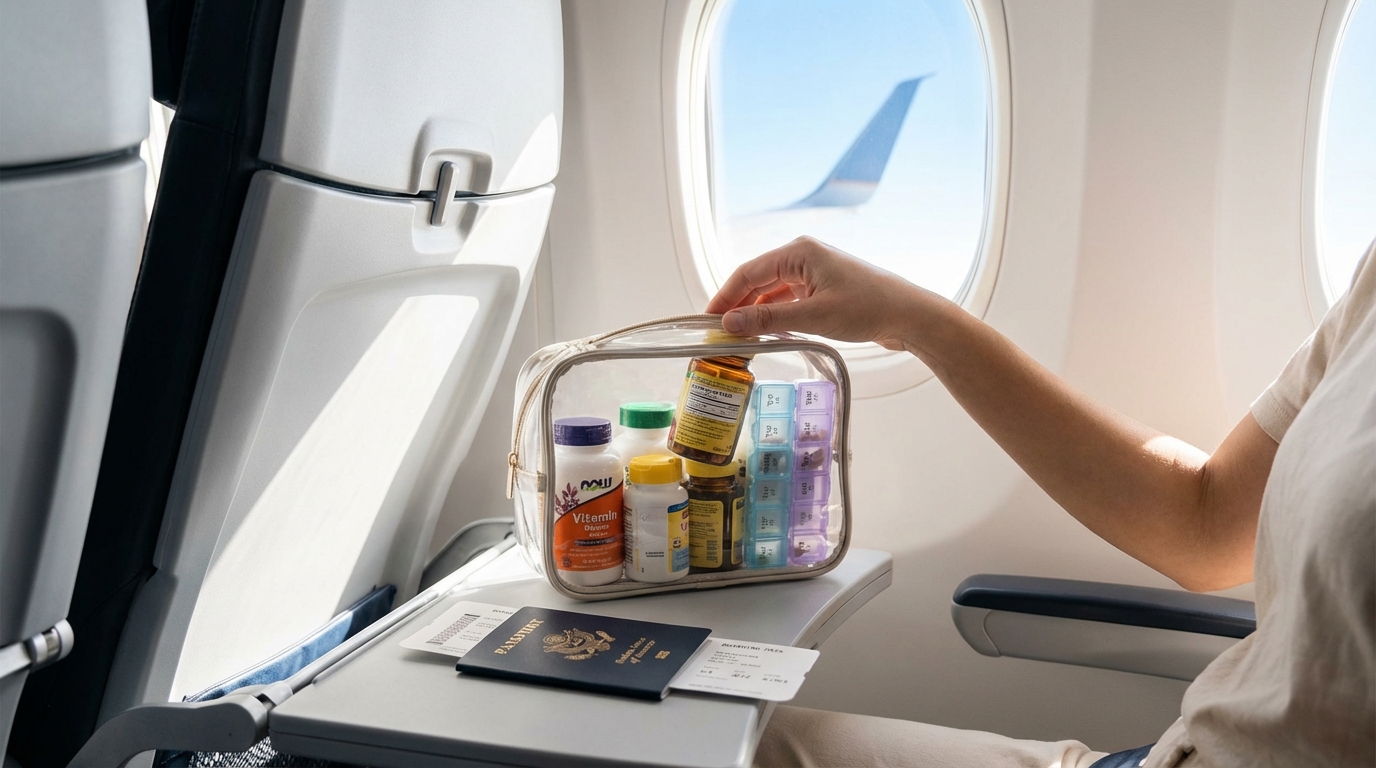
Quick Answer
Yes, you can bring vitamins on a plane in both carry-on and checked bags. Solid vitamins like pills, capsules, and gummies have no quantity limits. Liquid vitamins must follow the 3-1-1 rule (3.4 oz containers) in carry-on, and powder supplements over 12 oz may need extra screening.
The Short Answer
Vitamins are allowed on planes. You can bring them in your carry-on, your checked bag, or both. TSA doesn't restrict solid vitamins at all — no quantity limits, no special packaging requirements, nothing.
The rules only get specific when your vitamins are liquid or powder form. Here's the full breakdown.
Pill and Capsule Vitamins: No Restrictions
Tablets, hard capsules, softgel capsules — bring as many as you want. TSA doesn't limit the quantity of solid vitamins in either carry-on or checked bags. You could pack a year's supply and nobody would blink.
A few things worth knowing:
- Softgel capsules are NOT considered liquids. Even though they contain liquid inside, TSA treats them as solids. They don't count toward your 3-1-1 liquids allowance.
- You don't need original packaging. TSA doesn't require vitamins to be in their original bottles. You can transfer them to pill organizers, ziplock bags, or travel containers.
- That said, labels help. While not required, keeping at least one bottle with the original label can speed things up if a TSA agent asks what the pills are. This is especially true for vitamins that look unusual or could be mistaken for something else.
Gummy Vitamins: Also No Restrictions
Gummy vitamins are classified as solids by TSA. Bring as many as you want in carry-on or checked bags. No limits, no issues.
One practical tip though: gummy vitamins can melt. If your checked bag ends up sitting on a hot tarmac or in a warm cargo area, those gummies can fuse into one sticky blob. Consider keeping them in your carry-on where temperature is controlled, or pack them in an insulated pouch if you're checking them.
Liquid Vitamins: The 3-1-1 Rule Applies
This is where it gets specific. Liquid vitamins in your carry-on must follow the same 3-1-1 rule as every other liquid:
- Each container must be 3.4 ounces (100 mL) or smaller.
- All liquid containers must fit in a single quart-sized clear plastic bag.
- One quart bag per passenger.
If your liquid vitamin bottle is larger than 3.4 ounces, you have two options: transfer some into a smaller travel container for your carry-on, or pack the full bottle in your checked luggage where there are no liquid size limits.
This applies to liquid vitamin D drops, liquid iron supplements, liquid B12, fish oil in liquid form — anything that pours.
Powder Vitamins and Supplements: Extra Screening Over 12 Ounces
Protein powders, greens powders, collagen powder, powdered vitamin C — all allowed in both carry-on and checked bags. But there's a catch.
Containers of powder larger than 12 ounces (350 mL) may require additional screening at the TSA checkpoint. This doesn't mean they're banned. It means TSA might open the container, test it, or take extra time examining it.
To avoid delays:
- Pack powder supplements in checked luggage if they're large containers. You'll skip the extra carry-on screening entirely.
- If you must carry on a large powder container, pull it out and place it in a separate bin during screening, just like you would a laptop. This proactively shows TSA what it is and speeds things up.
- Consider pre-portioning into smaller containers. Travel containers under 12 ounces won't trigger extra screening.
Do You Need a Prescription or Doctor's Note?
No. Vitamins and supplements are over-the-counter products. TSA doesn't require prescriptions, doctor's notes, or any documentation for vitamins. This applies to all forms — pills, capsules, gummies, liquids, and powders.
This is different from prescription medications, which TSA recommends keeping in original pharmacy-labeled containers (though they don't strictly require it either).
Will TSA Stop You for Vitamins?
It's unlikely but possible. Here's when it might happen:
- Large quantities of loose pills. A ziplock bag full of assorted pills could raise a question. It takes two seconds to explain they're vitamins, but having original bottles or labels prevents the conversation entirely.
- Powder in large quantities. Anything over 12 ounces may get extra attention. Be prepared for your bag to be opened.
- Unusual-looking supplements. Some herbal supplements or specialty products might not look like typical vitamins. If the screener doesn't recognize them, they might ask.
In all these cases, TSA won't confiscate your vitamins. They might take an extra minute to inspect them, but you'll get through with everything intact.
Tips for Packing Vitamins for Air Travel
After dozens of trips with a supplement routine, here's what works:
- Use a pill organizer. A 7-day pill case keeps everything sorted and takes up way less space than multiple bottles. It's also faster to show TSA if they ask — everything is neatly laid out.
- Bring only what you need. Calculate your daily doses times the number of travel days, plus a couple extras for delays. Leave the jumbo Costco bottles at home.
- Keep them in your personal item. Vitamins in a backpack or purse are easy to access during your trip and won't get lost if your checked bag goes missing.
- Photograph your labels. Snap a quick photo of each vitamin bottle's label before you transfer pills to a travel organizer. If anyone asks what something is, you have proof on your phone.
- Consider vitamin packs. Companies like Vitafive and Persona sell pre-portioned daily supplement packs. They're already travel-sized and individually sealed.
International Travel With Vitamins
TSA rules cover departures from US airports. When flying internationally, keep a few things in mind:
- Some countries restrict certain supplements. What's a legal OTC supplement in the US might be regulated or banned elsewhere. Melatonin, for instance, requires a prescription in parts of Europe. DHEA is banned in some countries. Research your destination's rules before packing.
- Customs declarations may apply. Some countries ask you to declare vitamins and supplements on arrival. Keeping original packaging with ingredient lists makes customs clearance easier.
- Quantity matters internationally. Bringing 6 months of supplements might raise questions at foreign customs. Pack a reasonable travel supply.
CBD and Hemp Supplements
This is a special category worth calling out. CBD products derived from hemp (containing less than 0.3% THC) are federally legal in the US and TSA won't confiscate them. However, TSA officers can't test whether your CBD product meets that THC threshold on the spot.
If you're flying with CBD supplements:
- Keep them in original packaging with clear labels showing the CBD content and THC percentage.
- Liquid CBD oils follow the standard 3-1-1 rule in carry-on. Most tincture bottles are 1 oz (30 mL), which fits easily.
- CBD gummies and capsules have no carry-on restrictions.
- International travel is risky. Many countries have strict anti-cannabis laws that don't distinguish between CBD and THC. Countries like Japan, China, UAE, and others can impose serious penalties. Leave CBD supplements at home when flying internationally unless you've thoroughly researched your destination's laws.
Medically Necessary Supplements
If your vitamins or supplements are medically necessary — prescribed by a doctor for a deficiency or condition — you can request a TSA exemption from the 3-1-1 rule for liquids. Medically necessary liquids in reasonable quantities are allowed in carry-on bags even if they exceed 3.4 ounces.
Declare them to the TSA officer at the beginning of screening. They may test the liquid, but you'll be allowed to bring it through. Having a doctor's note or prescription label helps but isn't strictly required.
Frequently Asked Questions
Do vitamins need to be in original packaging for TSA?
No. TSA doesn't require vitamins to be in their original bottles. You can transfer them to pill organizers, ziplock bags, or any travel container. That said, keeping at least one original label can help if a TSA agent asks what the pills are.
Is there a limit on how many vitamins I can bring on a plane?
No limit for solid vitamins (pills, capsules, gummies). Bring as many as you need. Liquid vitamins in carry-on must be in containers of 3.4 ounces or less and fit in your quart-sized liquids bag.
Do softgel vitamins count as liquids for TSA?
No. Softgel capsules are treated as solids by TSA, even though they contain liquid inside. They don't count toward your 3-1-1 liquids allowance and have no quantity restrictions.
Can I bring protein powder in my carry-on?
Yes. Powder supplements are allowed in carry-on bags. However, containers over 12 ounces may require extra screening. Consider packing large quantities in checked luggage or pre-portioning into smaller containers.
Will TSA confiscate my vitamins?
No. TSA won't confiscate vitamins in any form — pills, capsules, gummies, or powders. They might take an extra minute to inspect unusual-looking supplements or large powder containers, but you'll keep everything.
Written by Aviation Experts
Aviation Professionals
With decades of combined experience in the aviation industry, our team shares insider knowledge to make your travel experience smoother and less stressful.
Was this article helpful?