Can You Bring a Curling Iron on a Plane?
Quick Answer
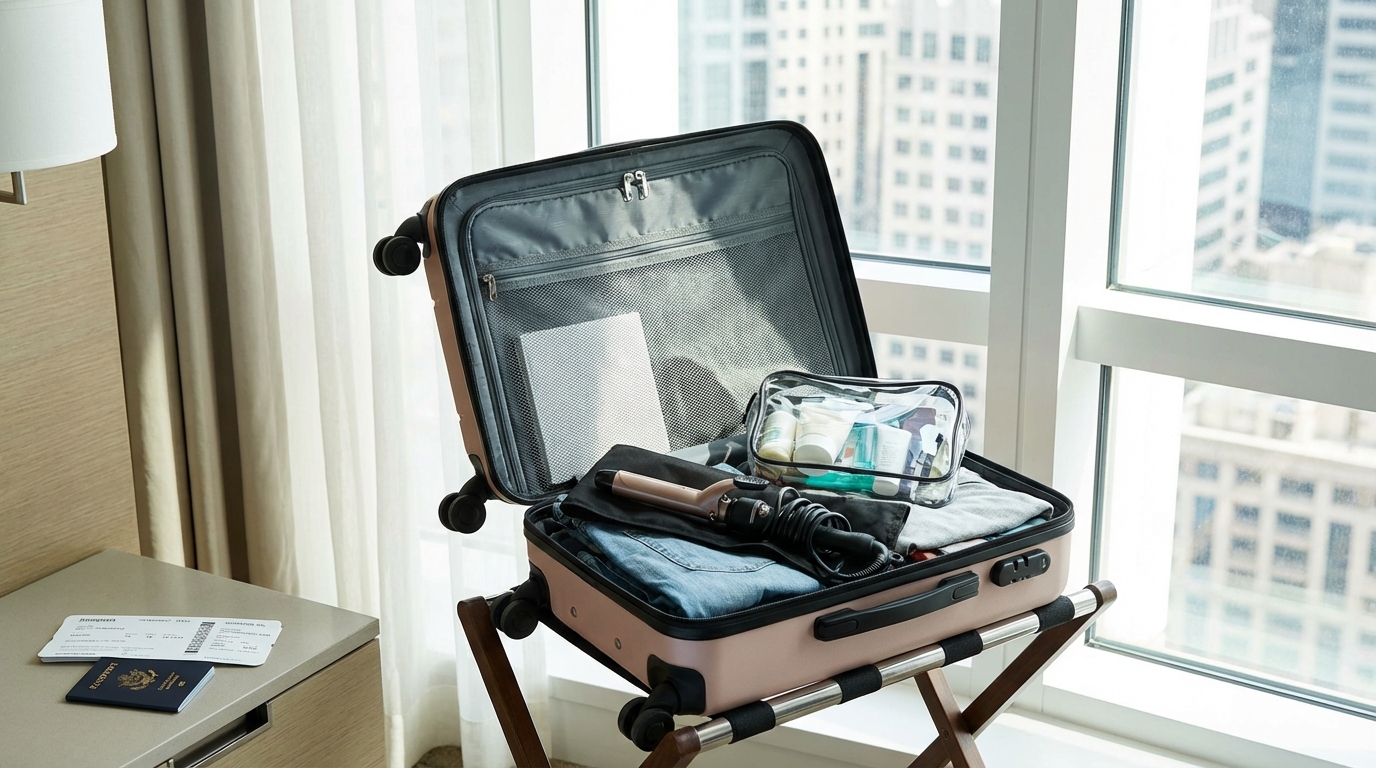
Yes, you can bring a curling iron on a plane. Corded curling irons are allowed in both carry-on and checked bags with no restrictions. Cordless curling irons powered by butane or gas cartridges are carry-on only and banned from checked luggage.
The Short Answer
You can absolutely bring a curling iron on a plane. But the rules depend on whether yours is corded or cordless, and the type of power source it uses. Get the wrong one in the wrong bag, and TSA will pull it out.
Here's the breakdown you need before you pack.
Corded Curling Irons: No Restrictions
If your curling iron has a regular power cord, you're golden. TSA allows corded curling irons in both carry-on bags and checked luggage with zero restrictions. No special packaging, no size limits, no drama.
Just make sure it's completely cooled down before you shove it in your bag. A hot curling iron pressed against your clothes or toiletries bag is a recipe for melted plastic and singed fabrics. If you're rushing to the airport, wrap it in a heat-resistant pouch or a thick towel.
This same rule applies to corded flat irons and straighteners. If it plugs into a wall, you can pack it anywhere.
Cordless Curling Irons: Carry-On Only
This is where things get tricky, and where a lot of travelers get caught off guard.
Cordless curling irons — the ones powered by butane, gas cartridges, or lithium batteries — are only allowed in carry-on bags. They're completely banned from checked luggage.
Why? Butane and gas cartridges are flammable. Lithium batteries can short-circuit and catch fire. In the cargo hold where nobody can respond to a fire, that's a serious hazard. In the cabin, the crew can deal with it immediately.
Requirements for Cordless Curling Irons in Carry-On
- Safety cover must be on. The heating element needs a protective cap or cover securely fitted over it. If your iron didn't come with one, buy a heat-resistant silicone cap before you fly.
- Must be protected from accidental activation. Lock it, turn it off, do whatever your model requires to make sure it can't turn on inside your bag.
- Spare gas cartridges are completely banned. You can't bring extra butane refills or spare gas cartridges in carry-on or checked bags. Period. Bring enough charge or fuel to last your trip, or buy refills at your destination.
The TSA's Recent Crackdown on Hair Tools
In mid-to-late summer of last year, the FAA updated its hazmat policy and the TSA followed suit, explicitly banning gas and butane-powered curling irons and flat irons from checked luggage. This wasn't a brand new rule per se — flammable items have always been restricted in the cargo hold — but the enforcement got much stricter.
What prompted it? A rise in incidents involving lithium batteries and pressurized gas cartridges in luggage fires. The FAA decided to draw a hard line: if your hair tool runs on butane or gas, it stays in the cabin with you.
If you've been tossing your cordless curling iron in your checked bag for years without any issues, those days are over. TSA is actively screening for these items now.
What About Lithium Battery Curling Irons?
Some newer cordless curling irons use rechargeable lithium-ion batteries instead of butane. The same core rule applies: carry-on only, not checked luggage.
Lithium battery devices have their own set of TSA and FAA guidelines:
- The battery must be under 100 watt-hours (Wh). Most personal grooming devices fall well under this limit. Your curling iron's battery is probably around 20-40 Wh.
- The device should be turned off (not just in standby mode) during the flight.
- If the battery is removable, you can keep it in the device or carry it separately, but spare batteries must always be in carry-on, never checked.
Check your curling iron's specs if you're unsure about the battery size. The watt-hour rating is usually printed on the battery itself or listed in the manual.
Packing Tips for Traveling With a Curling Iron
Whether corded or cordless, a few practical tips will save you hassle:
- Use a heat-resistant travel pouch. These cost a few bucks online and protect your bag from residual heat. They also keep your cord from tangling around everything else.
- Wrap the cord neatly. A tangled cord looks suspicious on an X-ray and can trigger a manual bag check. Loop it up and secure it with a twist tie or velcro strap.
- Pack it near the top of your bag. If TSA needs to inspect it, you don't want them digging through your entire suitcase. Put it somewhere accessible.
- Consider a travel-sized iron. Mini curling irons (typically 0.5-0.75 inch barrels) weigh less, take up less space, and do the job perfectly well for a trip. Brands like BaByliss, Conair, and Chi all make compact travel versions.
- Check the voltage. If you're flying internationally, your curling iron needs to support the local voltage (many countries use 220-240V vs the US's 110V). Dual-voltage curling irons handle both. If yours is single-voltage, you'll need a converter — not just a plug adapter.
Curling Iron Alternatives for Travel
If dealing with TSA rules sounds like too much hassle, here are some options:
- Heatless curling methods. Silk rollers, curling rods, and flexi-rods work overnight and take up almost no space. Zero TSA concerns.
- Use the hotel's tools. Many hotels provide hair dryers, and some higher-end ones offer curling irons or flat irons on request. Call ahead and ask.
- Buy a cheap corded iron at your destination. If you're going for a long trip and don't want to lug yours, a basic corded curling iron costs under $20 at any drugstore or big-box retailer.
International Considerations
TSA rules apply to flights departing from US airports. If you're flying internationally, keep these in mind:
- Most countries follow similar rules about butane and gas cartridges in checked luggage. The International Air Transport Association (IATA) guidelines align with what the TSA enforces.
- Some airlines have stricter policies. A handful of airlines ban all battery-powered heating devices entirely. Check your airline's specific prohibited items list before you pack.
- Airport security abroad may be less familiar with your device. If you have an unusual cordless curling iron, carry the manual or a printout of the TSA's policy to show screeners. It can speed things up.
What Happens If TSA Takes Your Curling Iron?
If you accidentally pack a cordless curling iron in your checked bag and TSA finds it during screening, they'll remove it. You won't get it back at your destination — it goes into the confiscated items bin.
If you have a cordless iron in your carry-on without the safety cover, TSA may confiscate it at the checkpoint. Some officers will let you through with a warning; others won't. Don't risk a $400 curling iron on whether your TSA agent is feeling generous.
The bottom line: put the safety cover on, pack cordless in carry-on, and you'll sail through security without thinking twice about your curling iron.
Frequently Asked Questions
Can I put a corded curling iron in my checked bag?
Yes. Corded curling irons are allowed in both carry-on and checked bags with no restrictions. Just make sure it's fully cooled down before packing.
Can I bring a butane-powered curling iron on a plane?
Yes, but only in your carry-on bag. Butane and gas-powered curling irons are banned from checked luggage. You must have a safety cover fitted over the heating element, and spare gas cartridges are completely prohibited.
Will TSA confiscate my curling iron?
TSA won't confiscate a corded curling iron. They may confiscate a cordless one if it's in your checked bag, if it doesn't have a safety cover over the heating element, or if you're carrying spare butane cartridges. Pack it in your carry-on with the cover on and you'll be fine.
Can I use my curling iron during a flight?
No. You can't use a curling iron on a plane. There are no outlets available for passenger use for grooming devices, and using a hot heating tool in a confined space would be a safety hazard. Wait until you reach your hotel.
Written by Aviation Experts
Aviation Professionals
With decades of combined experience in the aviation industry, our team shares insider knowledge to make your travel experience smoother and less stressful.
Was this article helpful?