Can I Bring 2 Backpacks on a Plane?
Quick Answer
Yes, you can bring 2 backpacks on a plane. Most airlines allow one carry-on bag and one personal item, so if one backpack fits as your carry-on and the other fits under the seat as your personal item, you're good to go.
The Quick Answer
You can bring two backpacks on a plane — as long as one serves as your carry-on and the other as your personal item. Every major airline allows passengers one carry-on bag plus one personal item. Neither has to be a specific type of bag, so two backpacks works perfectly.
The trick is size. Your carry-on backpack needs to fit in the overhead bin, and your personal item backpack needs to fit under the seat in front of you. If both bags meet those requirements, you're set. TSA doesn't care how many bags you bring through security — that's between you and your airline.
TSA vs. Airline Rules
This is an important distinction that confuses a lot of people:
- TSA doesn't limit your number of bags. Their job is screening what's inside your bags, not counting them. You could walk through security with five bags and TSA wouldn't say a word (as long as the contents pass screening).
- Airlines set bag limits. Your airline decides how many bags you can bring on the plane and what size they need to be. This is enforced at the gate, not at security.
So when someone says "you can't bring two backpacks," they're usually confusing TSA rules with airline rules. TSA is fine with it. Your airline is fine with it too, as long as both bags meet their size requirements.
Size Requirements by Airline
Here's where it gets specific. Your carry-on backpack and personal item backpack need to meet different size limits:
Carry-On Backpack (Overhead Bin)
Most airlines allow carry-ons up to these dimensions:
- American Airlines: 22 x 14 x 9 inches
- Delta: 22 x 14 x 9 inches
- United: 22 x 14 x 9 inches
- Southwest: 24 x 16 x 10 inches (more generous)
- JetBlue: 22 x 14 x 9 inches
- Alaska: 22 x 14 x 9 inches
A backpack in the 40-50 liter range typically fits these dimensions. Popular travel backpacks like the Osprey Farpoint 40, Tortuga Outbreaker 45, and Cotopaxi Allpa 42 are designed to hit these exact limits.
Personal Item Backpack (Under the Seat)
This is the tighter squeeze. Personal item dimensions vary more between airlines:
- American Airlines: 18 x 14 x 8 inches
- Delta: 18 x 14 x 8 inches
- United: 17 x 10 x 9 inches (notably narrower)
- Southwest: 18.5 x 8.5 x 13.5 inches
- JetBlue: 17 x 13 x 8 inches
- Frontier: 18 x 14 x 8 inches (but carry-on costs extra)
- Spirit: 18 x 14 x 8 inches (carry-on costs extra)
A day pack in the 18-25 liter range typically works as a personal item. Think JanSport-sized or slightly larger. Anything bigger and you risk it not fitting under the seat.
Budget Airlines: Watch Out
Here's where the two-backpack strategy gets complicated. Budget carriers have different rules that can cost you money:
- Spirit and Frontier: Your basic fare only includes a personal item. A carry-on bag costs extra ($35-65 depending on when you add it). If you show up at the gate with two backpacks and a basic fare, you'll pay a hefty fee for the second one.
- Allegiant: Same deal — personal item is free, carry-on costs extra.
- International budget carriers (Ryanair, Wizz Air): Even stricter. Some only allow a small personal item unless you pay for priority boarding or a carry-on add-on.
Always check what's included in your ticket class before assuming you can bring two bags for free.
The One-Bag Travel Hack
Some experienced travelers game the two-backpack system strategically. Instead of one big suitcase, they bring:
- A 40-45L travel backpack as their carry-on with all their clothes and gear.
- A packable daypack as their personal item with their laptop, chargers, snacks, and in-flight essentials.
This setup means no checked bags, no baggage fees, no waiting at the carousel, and no risk of lost luggage. For trips up to two weeks, it works surprisingly well if you pack smart.
The packable daypack is the key piece. Brands like Osprey (Ultralight Stuff Pack), Matador, and Tortuga make daypacks that scrunch down to almost nothing when empty, so you can stuff it inside your main backpack if you ever need to gate-check and consolidate.
What If Both Backpacks Are Big?
Here's the honest answer: if both your backpacks are full-size (think two 40L packs), you'll run into problems at the gate. Gate agents will measure bags that look too big, and automated bag sizers are increasingly common at boarding areas.
If your personal item doesn't fit under the seat, one of two things happens:
- The gate agent asks you to gate-check one bag. This is free but means one bag goes in the cargo hold.
- You get charged a checked bag fee. This is less common for honest mistakes but can happen on budget carriers.
Don't try to walk onto the plane with two obviously oversized backpacks. You'll get stopped, and the boarding area isn't the place to negotiate.
How to Make Two Backpacks Work
Here's the strategy that frequent two-bag travelers use:
Choose the Right Bags
- Carry-on backpack: A travel-specific backpack with a laptop sleeve, clamshell opening, and compression straps. 40-45L is the sweet spot.
- Personal item backpack: A slim, compact daypack. Look for bags marketed as "personal item size" or "under-seat bags." 18-22L works best.
Pack Smart
- Heavy stuff in the personal item. Your laptop, tablet, chargers, and books go under the seat. This keeps your carry-on lighter and easier to hoist into the overhead bin.
- Clothes and toiletries in the carry-on. This bag goes overhead, so weight matters less but bulk matters more. Use packing cubes to compress everything.
- Keep your quart bag accessible. TSA needs it out of your bag at security. Put it near the top of whichever backpack it's in, or in an easy-access pocket.
At the Airport
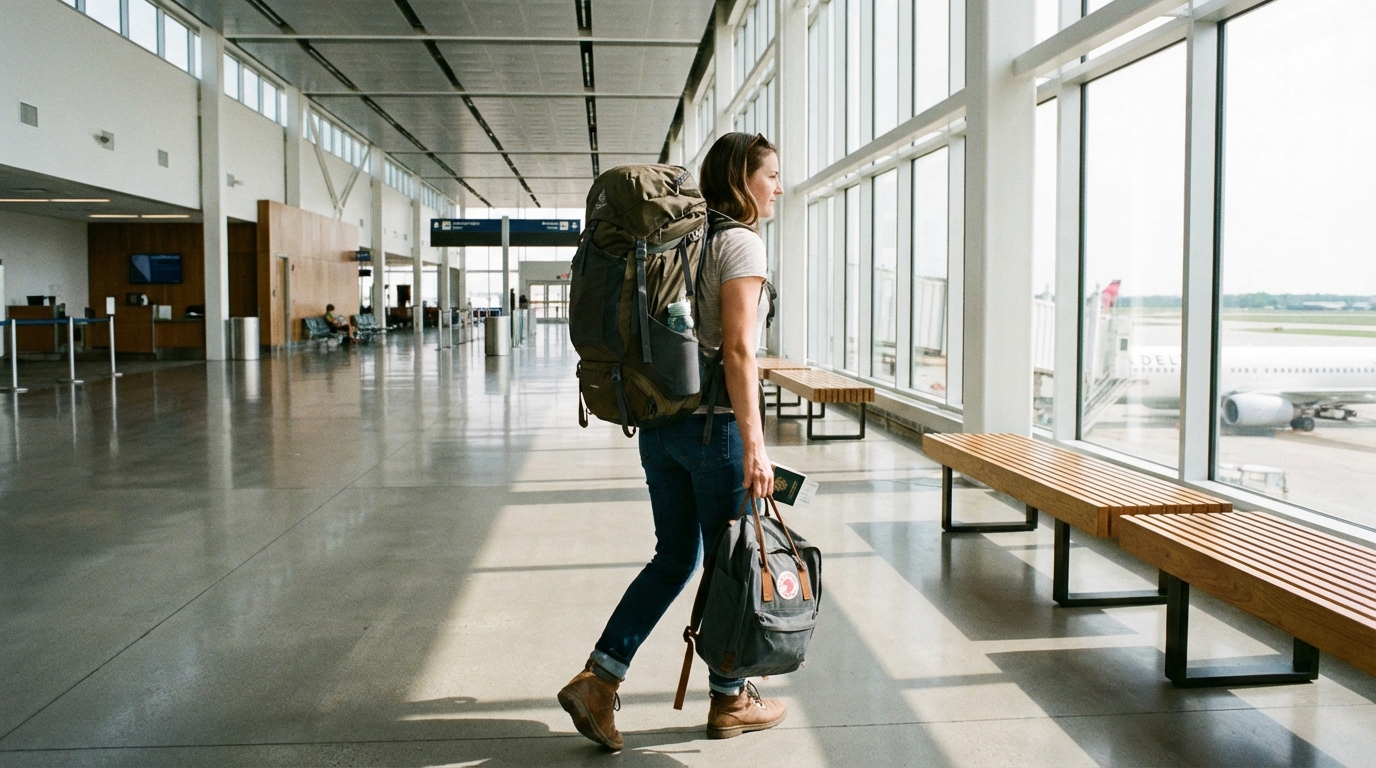
- Wear your carry-on on your back and carry the personal item by hand. This looks like one bag plus a small item, which draws less attention from gate agents.
- Board early if possible. Overhead bin space fills up fast. If your group boards late, you might be forced to gate-check your carry-on regardless of size.
- Be ready to consolidate. If overhead space is tight, you might be asked to put your personal item under the seat and fit your carry-on overhead. This is standard practice, so don't fight it.
What Counts as a Personal Item?
Airlines define personal items broadly. Any of these count:
- Small backpack or daypack
- Purse or handbag
- Laptop bag or briefcase
- Camera bag
- Diaper bag
- Small tote bag
The defining factor is whether it fits under the seat. If it does, it's a personal item. If it doesn't, it's a carry-on (and you can only have one of those).
Pro Tips
- Test the under-seat fit at home. Measure your personal item backpack against your airline's dimensions before you get to the airport. The space under most airplane seats is about 18 x 14 x 8 inches, but it varies by aircraft. Window and middle seats sometimes have slightly less room due to the curvature of the fuselage or seat supports.
- Clip or strap your personal item to your carry-on. Walking through the airport is easier when your bags are connected. Many travel backpacks have a front strap or passthrough sleeve for this purpose.
- Don't forget the weight. Two fully loaded backpacks can hit 30-40 lbs combined. That's a lot to carry through airports, onto shuttles, and up stairs. If you're doing a lot of walking between terminals, lighter is better.
- Check your airline's rules every time. Policies change, especially on budget carriers. What was free last year might cost money now.
Frequently Asked Questions
Does TSA care if I bring two backpacks?
No. TSA doesn't limit the number of bags you bring through security — they only screen what's inside. Bag limits are set by your airline, not TSA.
What size does my personal item backpack need to be?
Most airlines allow personal items up to about 18 x 14 x 8 inches. United is narrower at 17 x 10 x 9 inches. The bag must fit under the seat in front of you. A daypack in the 18-22 liter range usually works.
Can I bring two backpacks on Spirit or Frontier?
Only if you pay for a carry-on. Basic fares on Spirit, Frontier, and Allegiant only include one personal item for free. Bringing a second bag as a carry-on costs $35-65 extra depending on when you add it.
What happens if my personal item backpack is too big?
If it doesn't fit under the seat, the gate agent will likely ask you to gate-check one of your bags (free) or charge you a checked bag fee. Budget airlines are more likely to charge. Don't wait until boarding to find out — test the fit before your trip.
Written by Aviation Experts
Aviation Professionals
With decades of combined experience in the aviation industry, our team shares insider knowledge to make your travel experience smoother and less stressful.
Was this article helpful?