Red Eye Flights: Pros and Cons
Quick Answer
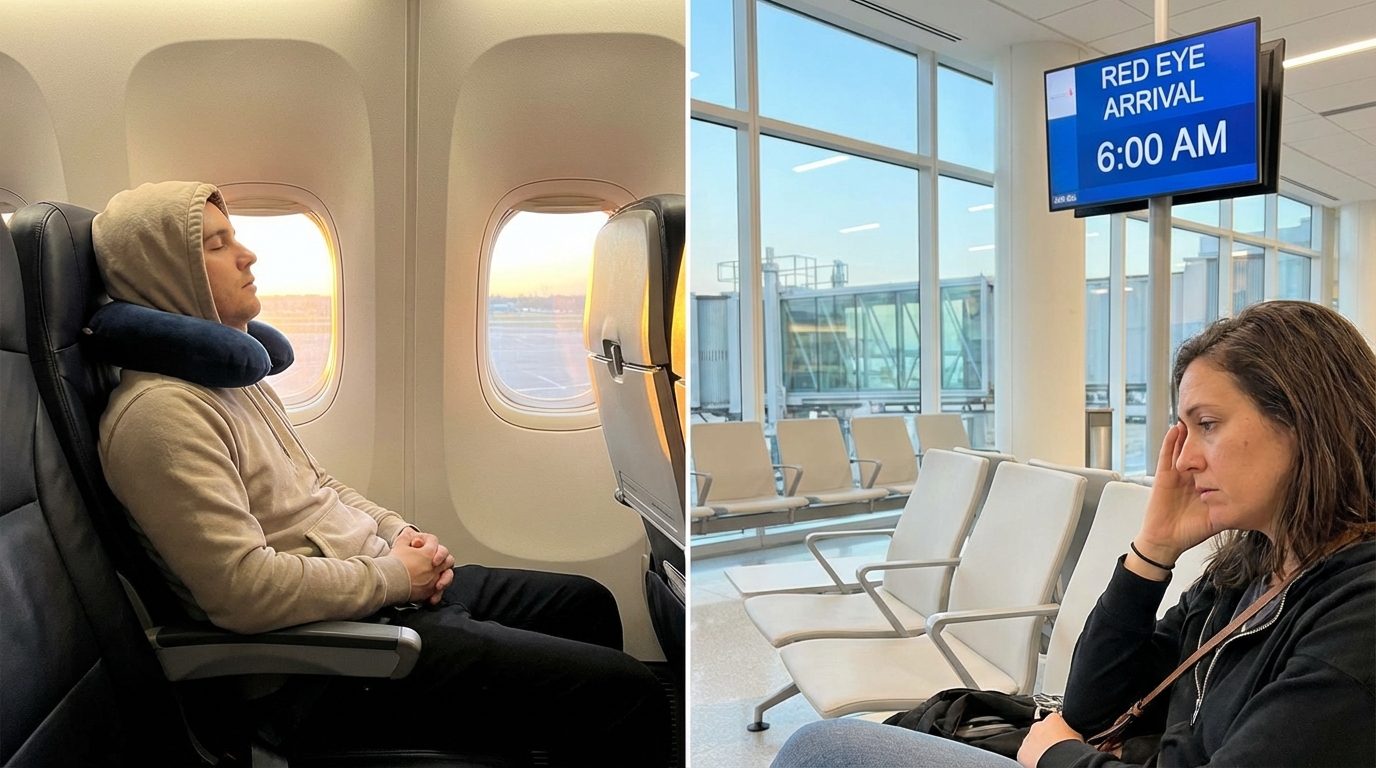
Red-eye flights are cheaper, less crowded, and save you a day of travel. But the sleep deprivation is real, and it can wreck your first day at the destination. Here's how to decide if it's worth it.
What Exactly Is a Red-Eye Flight?
A red-eye is any flight that departs late at night and arrives early the next morning. The name comes from the bloodshot eyes you'll be sporting when you land. Most red-eyes depart between 9 PM and 1 AM and arrive between 4 AM and 8 AM.
The classic red-eye routes are transcontinental — Los Angeles to New York, San Francisco to Boston, Seattle to Miami. These 4-6 hour flights are long enough to attempt sleep but short enough that you'll never get a full night's rest.
The Pros: Why People Love Red-Eyes
They're Cheaper
Red-eye flights are consistently among the cheapest departure times. Airlines discount them because demand is lower — most people don't want to fly at midnight. You can typically save 20-40% compared to a midday departure on the same route. On competitive routes, the savings can be even bigger.
You Save a Full Day
This is the killer advantage. Instead of burning a Saturday flying cross-country, you leave Friday night, sleep (sort of) on the plane, and arrive Saturday morning with the whole day ahead of you. For business travelers, this means no missed workdays. For vacationers, it's an extra day at your destination.
Airports Are Empty
Late-night airports are a completely different experience. Security lines are short — often nonexistent. Check-in counters are quiet. There's no jockeying for overhead bin space because the flight isn't full. The whole airport experience that normally takes 2 hours might take 30 minutes.
You Might Get Extra Space
Red-eyes frequently have empty seats. If the flight isn't full, you might score an empty middle seat next to you — or even an entire empty row. That kind of space is gold on an overnight flight. Some travelers specifically book red-eyes hoping for this.
Less Turbulence
Night flights tend to experience less turbulence than daytime flights. Convective turbulence — the kind caused by the sun heating the earth's surface — dies down after sunset. It's not guaranteed smooth sailing, but the odds are in your favor.
The Cons: The Case Against Red-Eyes
The Sleep Is Terrible
Let's be honest: sleeping on a plane in economy is awful. You're upright in a narrow seat with engine noise, cabin announcements, and the person next to you elbowing the armrest. On a 5-hour cross-country flight, you might get 2-3 hours of broken sleep if you're lucky.
Research analyzing 1.5 million nights of sleep data found that your sleep quality remains affected for 2-4 days after red-eye travel, with body clock misalignment peaking on days 2 through 4. That's a significant recovery period for one overnight flight.
Your First Day Is a Write-Off
You land at 6 AM, groggy and disoriented. Your hotel room isn't ready until 3 PM. You're wandering around a new city with bags under your eyes, too tired to enjoy anything but too wired to sleep. Many travelers find their first day after a red-eye is essentially wasted.
Limited Food and Services
Most airport restaurants and shops close by 9 or 10 PM. If your red-eye departs at midnight, you might not be able to grab food before boarding. On the plane, meal service is usually limited to a snack or nothing at all on domestic red-eyes.
Ground Transportation Is Harder
Arriving at 5 AM means public transit might not be running yet. Hotel shuttles may have limited early-morning schedules. Rideshare availability is lower, and surge pricing is possible. Plan your ground transportation in advance — don't assume you'll figure it out when you land.
It Gets Harder With Age
College students bounce back from a red-eye by lunch. Adults over 40 feel the effects for days. If you're not someone who can sleep anywhere, in any position, at any time, a red-eye might cost you more in lost productivity and enjoyment than it saves in ticket price.
Who Should Book Red-Eyes
Red-eye flights work best for:
- Business travelers who need to maximize working days and can nap at the hotel before afternoon meetings
- Budget travelers willing to trade comfort for savings
- People who can sleep anywhere — you know who you are
- Short trips where saving a day of travel matters more than arriving rested
- Travelers with airport lounge access — a shower and quiet space before a red-eye makes a huge difference
Who Should Avoid Red-Eyes
Skip the red-eye if:
- You have something important the next morning — a wedding, a meeting, a job interview. You need to be sharp.
- You're traveling with young kids — overtired children on a red-eye is misery for everyone within six rows
- You can't sleep sitting up — if you know this about yourself, accept it
- You have a long drive after landing — drowsy driving after a red-eye is genuinely dangerous
- The price difference is small — if you're saving $40, it's not worth the physical toll
Tips for Surviving a Red-Eye
Choose Your Seat Wisely
Window seat, every time. You get a wall to lean against, control over the shade, and nobody climbing over you to use the bathroom. Avoid the last row (seats don't recline) and seats near the galley or lavatory (noise and foot traffic).
Bring the Right Gear
The essentials for red-eye survival:
- Neck pillow — the U-shaped kind that supports your head from falling forward
- Eye mask — blocks cabin lights and the glow from other passengers' screens
- Earplugs or noise-canceling headphones — engine noise is relentless
- Blanket or large scarf — cabins get cold at night, and blanket availability is hit-or-miss
- Compression socks — reduces swelling on longer red-eyes
Skip the Caffeine and Alcohol
No coffee after noon on the day of your flight. No alcohol at the airport bar. Both disrupt sleep quality. If you need help falling asleep, melatonin (1-3 mg, taken 30 minutes before you want to sleep) is a better option than a glass of wine.
Eat Before You Board
Have a proper meal before you get to the airport. Don't rely on airport food (options are limited late at night) or in-flight service (minimal on red-eyes). A satisfied stomach helps you fall asleep faster.
Get Sunlight After Landing
When you arrive, get outside into natural light as soon as possible. Sunlight tells your body clock it's daytime and helps you push through the fatigue. Spending your first hour in a dark airport terminal or taxi will make the grogginess worse.
The Upgrade Calculation
If there's ever a time to splurge on a premium cabin, it's a red-eye. A lie-flat seat in business class transforms a miserable overnight experience into something resembling actual sleep. Check upgrade prices at check-in — airlines sometimes offer deeply discounted day-of upgrades on red-eyes because the flights aren't full.
Even a premium economy or extra-legroom seat can make a meaningful difference on an overnight flight. The extra recline and space is worth more at 1 AM than it is at 1 PM.
Bottom Line
Red-eyes are a tool, not a lifestyle. They make sense when the schedule savings matter and the price is right. They don't make sense when you need to be functional the next day. Be honest about how well you sleep on planes, factor in the recovery cost, and decide accordingly. The cheapest flight isn't always the best deal when you account for everything it costs you beyond the ticket price.
Frequently Asked Questions
Are red-eye flights cheaper than daytime flights?
Yes, red-eye flights are typically 20-40% cheaper than midday departures on the same route because demand is lower for overnight travel.
How do you sleep on a red-eye flight?
Book a window seat, bring a neck pillow, eye mask, and earplugs. Skip caffeine and alcohol before the flight. Take 1-3 mg of melatonin 30 minutes before you want to sleep.
Are red-eye flights less turbulent?
Generally yes. Convective turbulence caused by daytime surface heating dies down at night, so overnight flights tend to be smoother. It's not guaranteed, but the odds are better.
How long does it take to recover from a red-eye flight?
Research shows sleep quality can be affected for 2-4 days after red-eye travel, with body clock misalignment peaking on days 2 through 4. Most healthy adults feel normal again within 1-2 days.
Is it worth upgrading on a red-eye?
If you can afford it, a red-eye is the best time to upgrade. A lie-flat business class seat turns a miserable night into actual sleep. Check for day-of upgrade offers at check-in — red-eyes often have discounted upgrades.
Written by Aviation Experts
Aviation Professionals
With decades of combined experience in the aviation industry, our team shares insider knowledge to make your travel experience smoother and less stressful.
Was this article helpful?