How to Sleep on a Plane
Quick Answer
Sleeping on a plane isn't about luck. It's about preparation, the right gear, and a few smart choices that stack the odds in your favor.
The Short Answer
Book a window seat, bring an eye mask and earplugs, wear comfortable clothes, skip the alcohol, and use a quality travel pillow. That combination alone will dramatically improve your chances of actually sleeping on a plane.
Why Sleeping on a Plane Is So Hard
Your body doesn't want to sleep sitting upright in a noisy metal tube at 35,000 feet. The cabin pressure is equivalent to being at 6,000-8,000 feet elevation. The air is bone dry. There are babies crying, drink carts rolling, and a stranger's elbow in your ribs.
But people sleep on planes every single day. The difference between them and you isn't genetics. It's strategy.
Pick the Right Seat
The window seat is non-negotiable if sleep is your priority. You get a wall to lean against, nobody climbs over you to use the bathroom, and you control the window shade. That's three wins from one seat selection.
Beyond window vs. aisle, think about location. Seats over the wing experience less turbulence. Seats near the back are louder and bumpier. Seats near the galley and lavatories get constant foot traffic and noise.
If you're on a wide-body aircraft with a 2-3-2 or 2-4-2 configuration, the window seats in a two-seat section are gold. You only have one neighbor instead of two.
Build Your Sleep Kit
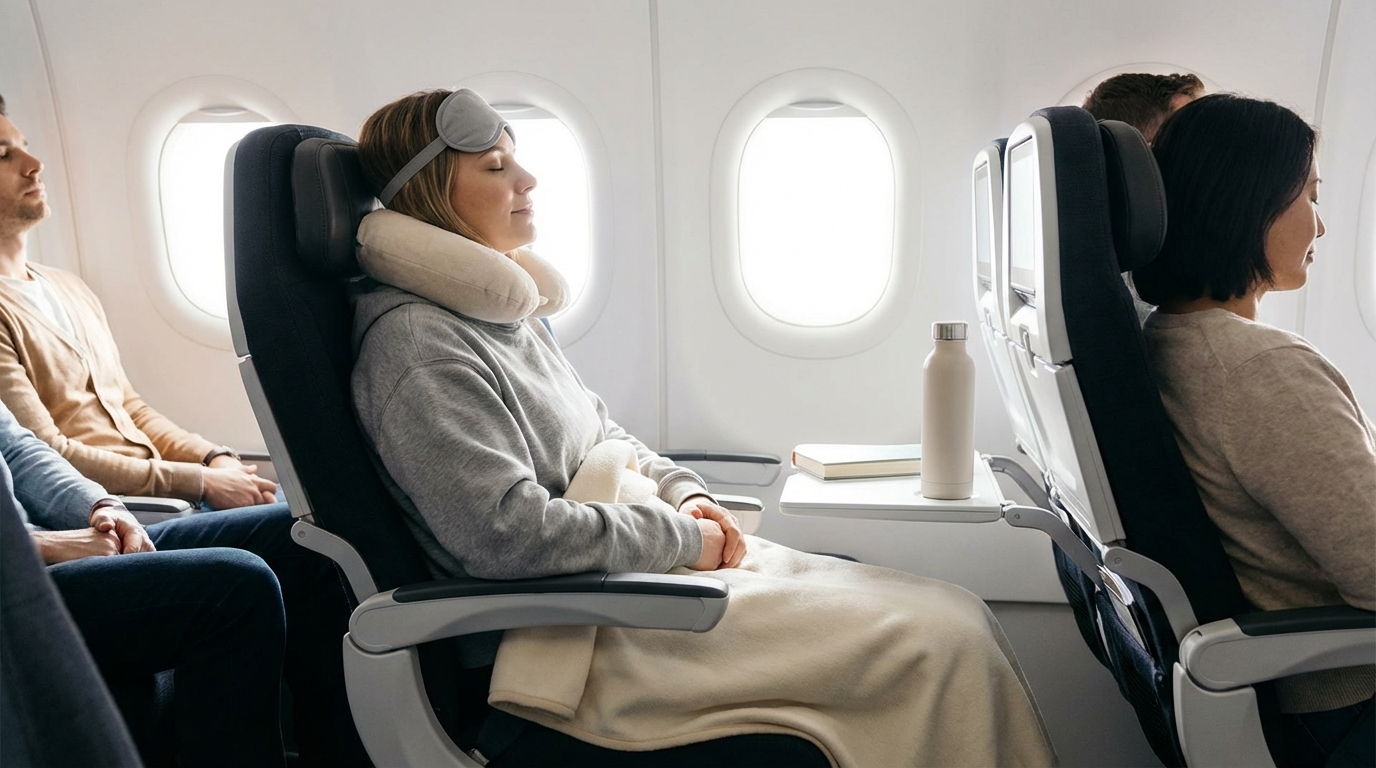
You need three things at minimum. An eye mask, earplugs or noise-canceling headphones, and a travel pillow. Everything else is a bonus.
Eye Mask
Cabin lights go on and off unpredictably. Your seatmate's screen glows like a lighthouse. A contoured eye mask that doesn't press on your eyelids makes a massive difference. Spend more than $5 on this. The cheap ones slide off and let light in around the nose.
Noise Cancellation
Foam earplugs are the budget option and they work surprisingly well. But noise-canceling headphones are a game changer because they kill the constant engine drone that keeps your brain alert. If you go with headphones, make sure they're comfortable enough to sleep in. Over-ear models can be bulky against a window or pillow.
Travel Pillow
Not all travel pillows are equal. The classic U-shaped inflatable from the airport shop is the worst option. It doesn't actually support your head from falling forward or sideways.
Better options include memory foam pillows like the Cabeau Evolution S3, which has a flatter design that keeps your neck properly aligned. The Trtl pillow takes a completely different approach with an internal support structure wrapped in fleece, and it packs down to half the size of a traditional pillow. For budget travelers, a large scarf or hoodie bunched up against the window works better than a cheap pillow.
What to Wear
Dress like you're going to a friend's couch, not a business meeting. Loose, stretchy clothing that doesn't dig into your waist or restrict your legs. Leggings, joggers, or soft pants. A layers system works best because cabin temperatures swing from freezing to stuffy.
Bring a pair of warm socks. Your feet get cold at altitude and cold feet make it harder to fall asleep. Some people bring a separate pair of cozy socks just for sleeping and put their shoes back on when they're awake.
If you're coming from work or a formal event, bring a change of clothes in your carry-on. Two minutes in the bathroom before settling in makes a huge difference.
What to Eat and Drink
This is where most people sabotage themselves.
Skip the alcohol. That glass of wine might feel relaxing, but alcohol disrupts sleep quality at altitude. You'll fall into a shallow, dehydrated sleep and wake up feeling worse than if you'd stayed awake.
Avoid caffeine for at least 4-6 hours before you want to sleep. That includes coffee, tea, cola, and chocolate.
Hydrate before boarding, not during the flight. Drinking a lot of water on the plane means bathroom trips that interrupt your sleep and annoy your seatmates. Front-load your hydration.
Eat a light meal before or early in the flight. A heavy meal makes you uncomfortable, while going to bed hungry keeps your brain active. Something with carbs and protein works well. Think sandwich, not steak.
Timing Your Sleep
If you're on a red-eye, try to stay awake until the cabin lights dim and meal service ends. Fighting to sleep while everything's happening around you is a losing battle.
On daytime flights, sync your sleep attempt with your destination's nighttime. If it's 2am where you're heading, that's a good time to close your eyes even if your body clock says it's 6pm.
Don't nap the day before an overnight flight if you can help it. Light exercise during the day helps too. You want your body genuinely tired, not just bored.
Sleep Position Matters
Leaning back to roughly 135 degrees is the ideal sleep position in a plane seat. It reduces pressure on your spine and lowers your risk of developing blood clots. Recline your seat as far as it goes. Yes, really. That's what the recline function is for.
If you're in a window seat, lean toward the wall with your pillow between your head and the fuselage. This is more stable than trying to sleep bolt upright.
Crossing your legs restricts blood flow. Keep your feet flat on the floor or slightly elevated on your carry-on bag under the seat in front of you.
Consider Sleep Aids
Melatonin is the gentlest option. A dose of 0.5-3mg taken about 30 minutes before you want to sleep can help signal your body that it's bedtime. It's not a sedative. It just nudges your internal clock.
Some travelers use antihistamines like diphenhydramine (Benadryl) or doxylamine. These work but can leave you groggy. Talk to your doctor first, especially if you're combining with other medications.
Prescription sleep aids are an option for long-haul flights, but never take one for the first time on a plane. Test it at home first. You don't want to discover side effects at 40,000 feet.
Set Up Your Space
Before you try to sleep, get everything organized. Put your phone, wallet, and anything you'll need when you wake up in the seat pocket. Stow your bag fully under the seat so you have foot room. Buckle your seatbelt over your blanket so flight attendants don't wake you during turbulence checks.
That last one is a veteran move. Flight attendants need to visually confirm your belt is fastened. If it's under a blanket, they'll tap your shoulder to check. Belt over the blanket means they can see it and let you sleep.
The 3-Day Pre-Flight Shift
If you're crossing multiple time zones, start shifting your sleep schedule three days before your flight. Move your bedtime one hour earlier (for eastbound) or later (for westbound) each day. By departure day, you're already partially adjusted. It takes roughly one day per time zone for your body to fully adapt, so any head start helps.
White Noise and Relaxation
If noise-canceling headphones aren't your thing, download a white noise or brown noise app before your flight. The steady hum masks sudden sounds like announcements, crying babies, and cart rattles that jolt you awake. Some people find rain sounds or ocean waves work even better than pure white noise.
Breathing exercises also help. The 4-7-8 technique is popular: breathe in for 4 seconds, hold for 7, exhale slowly for 8. It activates your parasympathetic nervous system, the part that tells your body it's safe to relax. Three or four cycles is usually enough to feel the shift.
What About Business Class?
If sleeping on a plane is genuinely important to you, a lie-flat business class seat changes the equation entirely. You go from "trying to sleep" to "actually sleeping" because you're horizontal. For red-eye flights or trips where you need to function the next day, the cost-per-hour-of-sleep math often works out better than you'd expect.
That said, everything in this guide still applies even in a flat seat. Eye mask, earplugs, hydration, and avoiding alcohol matter just as much whether you're in row 3 or row 33. The seat position changes, but your body's needs don't.
Frequently Asked Questions
What is the best seat for sleeping on a plane?
The window seat is the best choice for sleeping. You get a wall to lean against, nobody climbs over you to reach the bathroom, and you control the window shade. For even less disruption, pick a window seat in a two-seat section on wide-body aircraft.
Does alcohol help you sleep on a plane?
No. Alcohol might make you drowsy initially, but it disrupts sleep quality and worsens dehydration at altitude. You'll wake up feeling worse than if you'd stayed awake. Stick to water and skip the wine.
Is melatonin safe to take on a flight?
Melatonin is generally considered safe for short-term use. A dose of 0.5-3mg taken about 30 minutes before you want to sleep can help signal your body that it's time to rest. It's not a sedative, just a gentle nudge to your internal clock. Consult your doctor if you have concerns.
What's the best travel pillow for sleeping on a plane?
Memory foam pillows like the Cabeau Evolution S3 offer solid neck support and pack down small. The Trtl pillow uses an internal support structure and compresses to half the size of traditional pillows. Avoid cheap U-shaped inflatables from airport shops. They don't prevent your head from falling forward.
Should I buckle my seatbelt over or under my blanket?
Over the blanket. Flight attendants need to visually confirm your seatbelt is fastened during turbulence. If it's hidden under a blanket, they'll wake you to check. Keeping it visible lets them see you're buckled and leave you alone.
Written by Aviation Experts
Aviation Professionals
With decades of combined experience in the aviation industry, our team shares insider knowledge to make your travel experience smoother and less stressful.
Was this article helpful?