Business Class vs Premium Economy: Is It Worth It?
Quick Answer
Premium economy costs about 1.5-2x economy. Business class costs 3-5x. The gap between them is massive in both price and product. Here's when business class is worth the splurge and when premium economy is the smarter play.
The Straight Answer
Business class is worth it for overnight flights where sleep determines your next day. Premium economy is enough for daytime flights and trips where you just want more comfort without blowing your budget.
The single biggest difference between these two cabins? The seat goes flat in business class. That changes everything on a 10-hour overnight flight and almost nothing on a 4-hour daytime hop. Let's dig into the details.
What You Get in Premium Economy
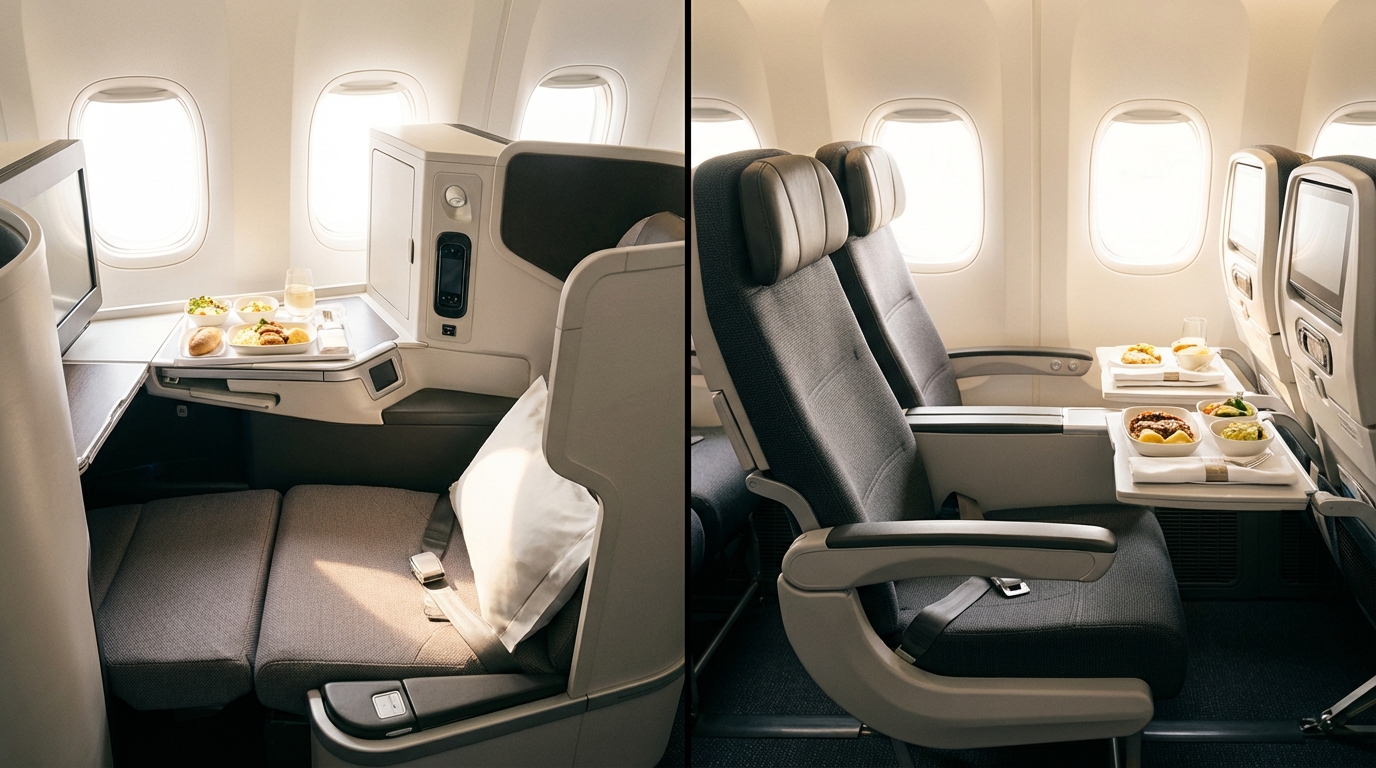
Premium economy sits in a weird middle ground — better than economy in every way, but nowhere close to business class. Here's the typical product:
- Seat width: 18-19.5 inches (vs. 17-18 in economy)
- Seat pitch: 36-40 inches (vs. 30-32 in economy)
- Recline: 6-8 inches (vs. 3-5 in economy)
- Legrest: Yes, on most airlines
- Meal service: Economy-plus — same food, better presentation, sometimes wine included
- Amenity kit: Basic — eye mask, socks, maybe a small tube of lotion
- Screen size: 12-13 inches (vs. 10-11 in economy)
- Baggage: Usually 2 checked bags included
- Priority boarding: Yes, on most airlines
The key thing premium economy does not give you: a flat bed. The seat reclines more than economy, but you're still sleeping upright. On a daytime flight, that's fine. On a red-eye, it's the crucial gap.
What You Get in Business Class
International business class on most major airlines now includes:
- Seat width: 20-23 inches
- Seat pitch: 43-78 inches (lie-flat)
- Lie-flat bed: 180 degrees, with mattress pad and duvet
- Direct aisle access: 1-2-1 layout on most carriers
- Meal service: Multi-course restaurant-quality dining, wine list, dine-on-demand on some airlines
- Amenity kit: Premium brand, full-size items
- Screen size: 15-18 inches
- Baggage: 2-3 checked bags
- Lounge access: Full airline lounge with food, drinks, showers
- Priority everything: Check-in, security, boarding, baggage claim
The lie-flat seat is the game-changer. Combined with lounge access before the flight and priority service throughout, business class turns a long-haul flight from an ordeal into a genuine rest period.
The Price Gap
Here's where reality hits. On a typical transatlantic route:
- Economy: $750-$950 round-trip
- Premium economy: $1,200-$1,600 round-trip (1.5-2x economy)
- Business class: $3,500-$5,000 round-trip (3-5x economy)
That means the jump from premium economy to business class is roughly $2,000-$3,500. That's a lot of money — easily enough to cover a few nights at a nice hotel at your destination.
On Asia-Pacific routes, the gap is even wider. Business class to Tokyo or Sydney can run $6,000-$9,000 round-trip, while premium economy sits at $2,000-$3,000.
When Business Class Is Worth It
Overnight Flights Where You Need to Function the Next Day
This is the strongest case for business class. If you're flying overnight from New York to London and have a meeting at 9 AM, the lie-flat seat isn't a luxury — it's a necessity. Business class passengers on overnight flights typically sleep 5-7 hours and arrive functional. Premium economy passengers get 2-4 hours of broken rest and spend the next day in a fog.
If one day of lost productivity or a ruined first vacation day costs you more than the price difference, business class pays for itself.
Flights Over 10 Hours
Any flight over 10 hours in an upright seat is grueling. Your back hurts, your legs swell, and the discomfort compounds by the hour. Business class eliminates this entirely. On ultra-long-haul routes (15+ hours to Australia, Singapore, or South Africa), business class goes from "nice to have" to "strongly recommended" for most adults.
When You're Using Miles or Points
Business class redemptions are where frequent flyer programs shine. A ticket that costs $5,000 cash might cost 70,000-90,000 miles. If you've accumulated points through credit card spending, this is the best value redemption in the game. The sweet spot: transfer credit card points to airline partners for business class award seats.
When You Find a Deal
Business class sales and mistake fares happen more often than you'd think. Fares sometimes drop to $1,500-$2,500 round-trip on transatlantic routes. At that price, you're paying just $300-$900 more than premium economy — an easy yes. Set fare alerts on Google Flights and follow deal-tracking accounts.
When Premium Economy Is the Smarter Choice
Daytime Flights
If you're not sleeping, the lie-flat bed loses its primary advantage. On a 9 AM departure landing at 5 PM, you'll watch movies, read, eat, and maybe nap. Premium economy is perfectly comfortable for all of that, and you'll save $2,000-$3,500.
Short-Haul International Flights
Flights under 6 hours don't give you enough time to fully benefit from a lie-flat seat. By the time they serve dinner and breakfast, you've got maybe 4 hours of sleep time regardless of your seat position. Premium economy's extra recline and legroom are often sufficient.
When the Price Gap Is Huge
If business class is 5x economy and premium economy is 1.5x, the math doesn't work for most leisure travelers. That extra $3,000-$4,000 buys a lot of experiences at your destination. Premium economy gives you enough comfort to arrive in decent shape without draining your travel budget.
Multi-Leg Trips
If your itinerary has 3-4 flights, buying business class for all of them adds up fast. A smarter play: fly premium economy on shorter legs and splurge on business class only for the longest overnight segment.
Airline-Specific Considerations
Not all premium economy and business class products are equal:
- Best premium economy: JAL, ANA, Singapore Airlines, and Air New Zealand offer exceptional premium economy with generous pitch, wide seats, and good food
- Best business class value: Turkish Airlines, Qatar Airways, and EVA Air deliver top-tier business class at lower price points than European and U.S. carriers
- Biggest gap between cabins: On airlines like British Airways, the jump from premium economy (called World Traveller Plus) to business class (Club World) is enormous — premium economy is barely better than economy on some older aircraft
- Smallest gap: Airlines like JetBlue (Mint vs. Even More Space) and some Asian carriers have premium economy products that punch well above their weight class
The Hybrid Strategy
If you can't justify business class for the whole trip, consider these approaches:
- One-way upgrade: Fly business class on the outbound red-eye and premium economy on the daytime return. You arrive rested and save on the return when you don't need the bed.
- Bid for upgrade: Many airlines (Qantas, Virgin Atlantic, Lufthansa) let you bid on upgrades from premium economy to business class. Bids of $400-$800 are sometimes accepted, getting you a $3,000+ product at a fraction of the cost.
- Credit card perks: Some premium travel credit cards offer automatic upgrades, companion passes, or statement credits that close the gap.
What About Domestic Premium Economy?
On domestic U.S. flights, the terminology shifts. What airlines call "premium economy" or "extra legroom" seating (Delta Comfort+, United Economy Plus, American Main Cabin Extra) is a milder upgrade — typically just 3-5 extra inches of pitch and free drinks. These seats cost $30-$100 more per segment and are almost always worth it on flights over 3 hours.
The real premium economy product — with wider seats, better food, and enhanced amenity kits — is primarily an international long-haul offering. Don't expect the same experience on a domestic flight labeled "premium economy."
The Bottom Line
Business class is worth the money for overnight flights where you need to function the next day, flights over 10 hours, or when you find a sale or use points. In all other scenarios, premium economy delivers 70% of the comfort at 30% of the price premium. The smartest travelers don't commit to one cabin for every flight — they match the product to the trip.
Frequently Asked Questions
How much more does business class cost compared to premium economy?
On typical transatlantic routes, premium economy runs $1,200-$1,600 round-trip while business class costs $3,500-$5,000, making business class roughly 2-3x the price of premium economy. On Asia-Pacific routes, the gap can be even wider. The exact difference depends on the airline, route, and how far in advance you book.
Does premium economy include lounge access?
Generally no. Premium economy tickets don't include airline lounge access on most carriers. Some exceptions exist — certain airlines offer lounge access to premium economy passengers on specific routes, and you can always buy a day pass or access lounges through credit card memberships like Priority Pass. Business class tickets always include lounge access.
Can you sleep in premium economy?
You can doze, but you can't truly sleep the way you would in business class. Premium economy seats recline 6-8 inches and have a legrest, but you're still in an upright position. Most passengers get 2-4 hours of broken rest. Business class lie-flat beds allow 5-7 hours of real sleep on overnight flights.
Is it better to use miles for business class or buy premium economy?
Using miles for business class is generally the best value redemption in frequent flyer programs. A business class ticket that costs $5,000 cash might cost 70,000-90,000 miles. If you have the miles, this is almost always a better deal than spending cash on premium economy. Save your cash and use your points for the upgrade.
Which airlines have the best premium economy?
JAL, ANA, Singapore Airlines, and Air New Zealand consistently rank among the best premium economy products, with wider seats, more pitch, and better food than competitors. On the other end, some airlines like British Airways have older premium economy products that barely feel like an upgrade from economy. Research the specific aircraft and seat on your route before booking.
Written by Aviation Experts
Aviation Professionals
With decades of combined experience in the aviation industry, our team shares insider knowledge to make your travel experience smoother and less stressful.
Was this article helpful?