How to Find Your Gate at the Airport
Quick Answer
Finding your gate is one of the easiest parts of flying once you know where to look. Here's how to go from the security exit to your boarding area without stress.
Check Your Boarding Pass First
Your gate number is printed right on your boarding pass. It's usually a letter-number combination like B12, C45, or A3. The letter refers to the terminal or concourse (a wing of the airport), and the number is the specific gate within that concourse.
If you checked in on your phone, your gate shows in the airline's app. Pull it up before you even walk into the airport so you know where you're heading.
But here's the thing you need to know: the gate on your boarding pass isn't always final. Airlines change gates all the time. Sometimes an hour before departure, sometimes 15 minutes before. Your boarding pass gives you a starting point, but you need to verify it once you're inside.
Verify on the Departure Monitors
After you clear security, look for the large screens displaying flight information. They're everywhere: at security exits, in hallways, near food courts, at corridor intersections. These departure boards show every outgoing flight with:
- Flight number
- Destination city
- Departure time
- Current gate
- Status (On Time, Boarding, Delayed, Gate Change)
Find your flight on the board. The gate shown here is the most up-to-date information available. If it's different from your boarding pass, go with the monitor. The monitor wins every time.
Make a mental note of the gate and start heading that direction.
Follow the Signs
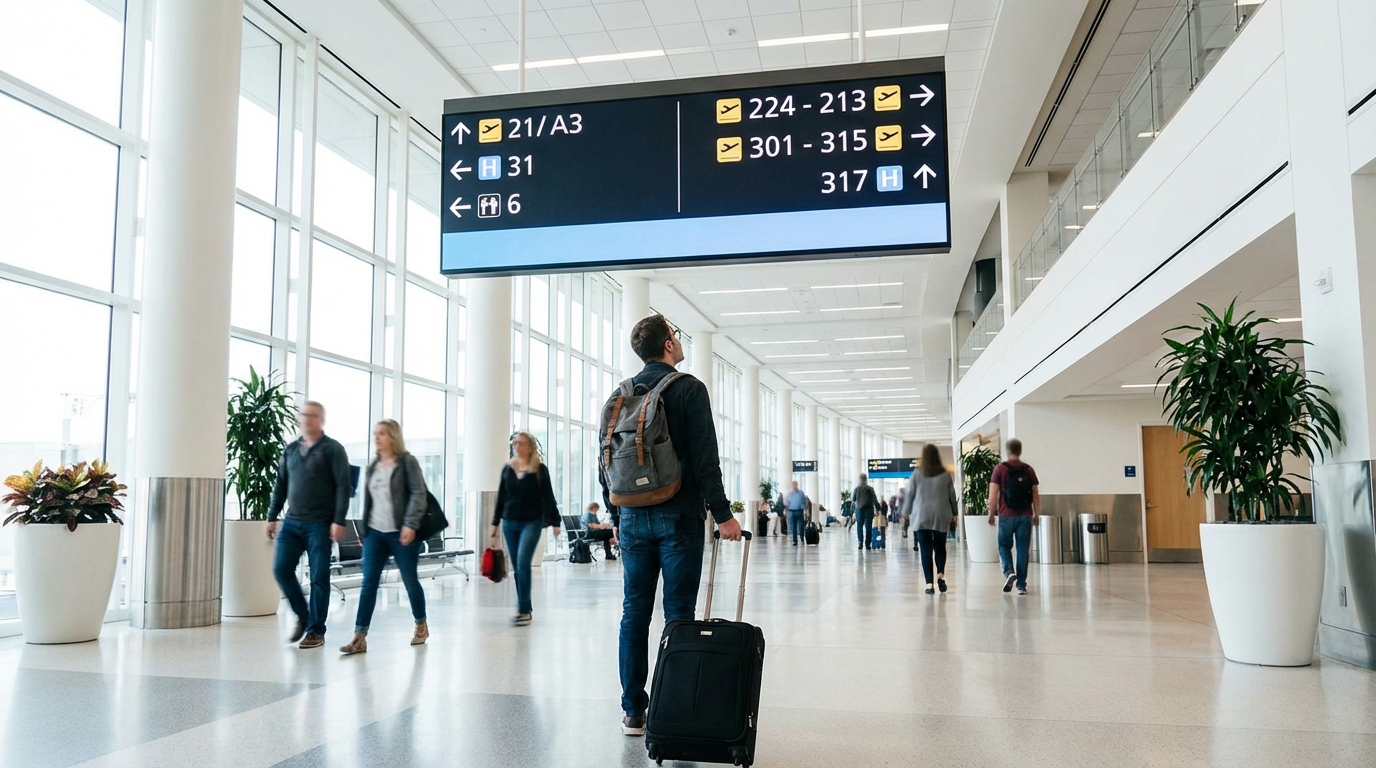
Airports are designed so that you don't need a map. After security, look up. Overhead signs point you toward gate ranges, things like "Gates A1-A20" with an arrow pointing left, or "Gates B21-B40" with an arrow pointing right.
Just follow the arrows that include your gate number. It's that simple.
Here's how airport signage typically works:
- Concourse letters are posted at junctions where hallways split. Follow your letter.
- Gate number ranges narrow down as you get closer. You might see "Gates B1-B40" at first, then "Gates B20-B40" after a turn.
- Individual gate numbers are posted above each gate's seating area.
The gates are numbered sequentially. If you're standing at B10 and need B22, keep walking in the direction of increasing numbers. If you're at B30 and need B22, turn around.
Navigating Large Airports
At a small regional airport with 10 gates, you can see your gate from the security exit. Finding it takes about 60 seconds.
At a major hub, things get more involved. Here's what to expect at the big airports:
Airports with Trains Between Concourses
Some airports are so large that you need to take an automated train (sometimes called a "people mover" or "SkyTrain") to get between concourses. Atlanta's Hartsfield-Jackson has nearly 200 gates across seven concourses, all connected by an underground train. Denver, Dallas/Fort Worth, and Orlando have similar systems.
Follow the signs to the train. They're free, run every couple of minutes, and announce each concourse stop. Get off at yours and follow the signs to your gate.
Airports with Multiple Terminals
Some airports like JFK, LAX, and London Heathrow have completely separate terminal buildings. If your connecting flight is in a different terminal, you may need to take a shuttle bus or train between buildings. At some airports, this means going back through security. Allow extra time.
Walking Distances
Don't underestimate how far the walk can be. At large airports, getting from security to a distant gate can take 15 to 25 minutes on foot. At the biggest hubs, it can push 30-40 minutes if you're going end to end. Wear comfortable shoes, and if you see moving walkways (those flat escalator-like conveyor belts in the floor), use them.
What to Do When Your Gate Changes
Gate changes are common and usually not a big deal. Here's how to handle them:
Enable App Notifications
Your airline's app will send you a push notification the moment your gate changes. This is the fastest way to find out. If you haven't downloaded your airline's app yet, do it before you fly.
Check Monitors Regularly
If you're wandering the terminal, shopping, or eating, glance at a departure board every 15-20 minutes. Gate changes can happen at any point, even after you've already been sitting at the original gate.
Listen for Announcements
Gate agents announce changes over the PA system. But airports are noisy, and you might miss it, especially if you have headphones on. Don't rely on announcements alone.
Verify at the Gate
When you arrive at your gate, look at the screen mounted above the gate counter. It should display your flight number and destination. If it shows a different flight, your gate has probably changed. Check the monitors or ask the agent at the counter.
When to Be at Your Gate
Boarding typically starts 30 to 50 minutes before departure. International flights and wide-body aircraft tend to board earlier because there are more passengers to seat.
The boarding door closes 10 to 15 minutes before departure. Once it closes, it doesn't reopen. You could be standing 20 feet away, and they still won't let you on.
The smart move: find your gate first, confirm it's correct on the screen, then go explore the terminal if you have time. Grab food, browse a shop, charge your phone. Just be back at your gate when boarding starts. Set a phone alarm if you need to.
Helpful Tools
- Airline apps show your gate in real time, push gate change alerts, and some include terminal maps with walking time estimates.
- Airport apps many major airports have their own apps with interactive maps, food and shop directories, and gate locations.
- Google Maps has indoor maps for many large airports. Search for the airport and zoom in to see terminal layouts.
- Airport information desks are staffed with people whose entire job is to help you find where you're going. Don't be shy about asking.
- Any airline employee can look up your gate. If you're confused, walk up to any gate counter and ask. They're happy to help.
Connecting Flights: Finding Your Next Gate
If you're on a connecting flight, finding your next gate works the same way. When you land, check the departure monitors in the terminal for your connecting flight's gate. Your airline's app will also show the updated gate for your next leg.
For domestic connections in the U.S., you stay inside the secure area. No need to go through security again. Just walk (or take the train) to your next gate.
If your connection is tight, less than an hour, head straight to the gate. Don't stop for food. You can eat on the next flight or at your destination. Making the connection is what matters.
If your connection is comfortable (90 minutes or more), find your gate first, confirm the flight is on time, then grab food or stretch your legs.
Common Mistakes to Avoid
First-timers make a few predictable errors when finding their gate. Here's what to watch out for:
- Trusting the boarding pass gate blindly. Your boarding pass gate is assigned when you check in, which could be 24 hours before the flight. A lot can change. Always verify on the monitors.
- Wandering too far from the gate. Airport terminals are full of tempting shops and restaurants. That's fine, but keep your gate within a reasonable walk. If you're in Concourse A and your gate is in Concourse D, don't browse shops in A and then try to sprint to D when boarding starts.
- Ignoring the gate screen. When you arrive at your gate, check the screen above the counter. If it shows a different flight number or destination, don't just sit down and assume it'll change. Your gate may have already switched. Verify immediately.
- Not allowing enough walking time. At major airports, the walk from security to a far gate can easily take 20 minutes. If you clear security with only 25 minutes to spare and your gate is a 15-minute walk, you're already cutting it dangerously close.
- Forgetting about time zones. If you're connecting through an airport in a different time zone, make sure you're reading departure times correctly. Your phone usually updates automatically, but airport clocks and monitors show local time.
What the Gate Area Looks Like
When you arrive at your gate, here's what you'll see. There's a counter with airline staff (the gate agents), a screen showing flight information, rows of chairs, and a door leading to the jet bridge, which is the enclosed walkway that connects the terminal to the airplane.
Some gates have power outlets near the seats for charging your devices. Others have USB ports built into the chair armrests. Not every seat has one, so if you need a charge, scout for an available outlet when you first arrive.
The gate area is also where you'll hear boarding announcements. Gate agents use a microphone at the counter to call boarding groups. Stay close enough to hear them, or keep an eye on the line forming at the jet bridge door. When people start queuing up with boarding passes in hand, that's your cue to check if your group has been called.
Frequently Asked Questions
Where do I find my gate number?
Your gate number is on your boarding pass and in your airline's app. After clearing security, verify it on the airport departure monitors. The monitors have the most current information since gates can change at any time.
How early should I be at my gate?
Be at your gate when boarding starts, which is typically 30 to 50 minutes before departure. The boarding door closes 10 to 15 minutes before departure and won't reopen. Find your gate early, then explore the terminal if you have time.
What do I do if my gate changes?
Check the departure monitors for your new gate and head there. Enable notifications in your airline's app for the fastest updates. If you're unsure, ask any airline employee at a nearby gate counter to look up your current gate assignment.
How long does it take to walk to my gate?
At small airports, 2 to 5 minutes. At major hubs like Atlanta, Denver, or Dallas/Fort Worth, it can take 15 to 25 minutes, especially if you need to take a train between concourses. Check your airport's layout before traveling and wear comfortable shoes.
What if I can't find my gate?
Ask for help. Airport information desks and any airline employee can point you in the right direction. Follow overhead signs toward your gate letter and number range. If you're completely lost, look for the nearest departure monitor, confirm your gate, and follow the signs from there.
Written by Aviation Experts
Aviation Professionals
With decades of combined experience in the aviation industry, our team shares insider knowledge to make your travel experience smoother and less stressful.
Was this article helpful?