Flying With a Baby vs Driving: Which Is Easier?
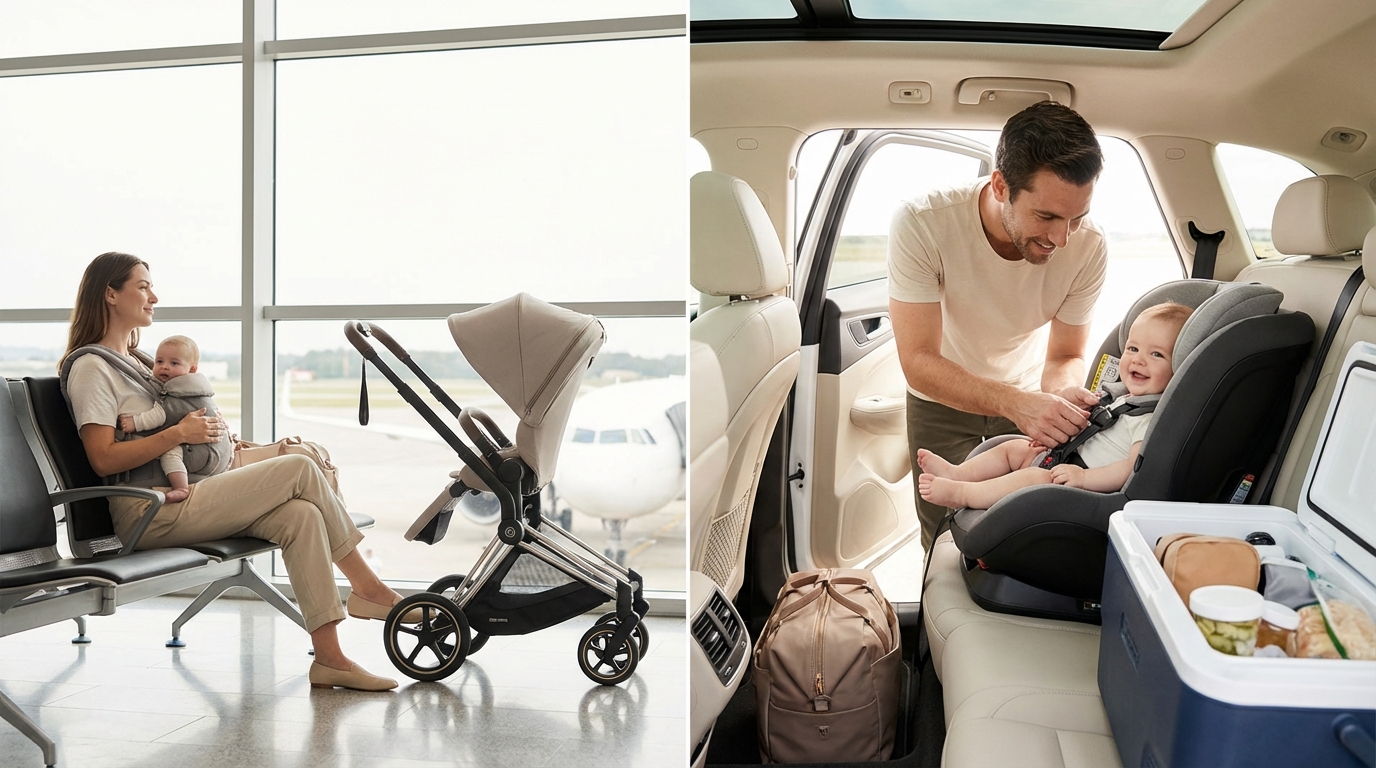
Quick Answer
Under 5 hours of driving? Drive. Over 5 hours? Fly. But it's not just about distance — your baby's age, temperament, and the number of adults in your travel party matter just as much.
The General Rule
If the drive is under 5 hours, drive. If it's over 5 hours, fly. That's the tipping point where the hassle of airports becomes less painful than a marathon car ride with a baby who's done being in a car seat. But this rule has exceptions, and they all depend on your specific kid and your specific trip.
The Real Cost Comparison
Let's talk money first, because it's the easiest thing to calculate.
Flying Costs
- Lap infant (under 2): Free on domestic flights. You don't need to buy a ticket if your baby sits on your lap.
- International lap infant: Typically 10% of the adult fare.
- Buying a seat for baby: Full ticket price, but your baby can ride in their car seat — much safer and more comfortable.
- Checked bags: $35-$50 per bag each way. You'll need at least one extra bag for baby gear.
- Car seat and stroller: These fly free as checked items on all major U.S. airlines. Gate-check the stroller — you'll want it in the terminal.
For two parents and a lap infant flying domestic round-trip, you're looking at 2 adult tickets plus baggage fees. Call it $400-$800 depending on the route.
Driving Costs
- Gas: Roughly $0.15-$0.20 per mile in a typical family car.
- Food stops: $20-$40 per meal stop, and you'll make more of them with a baby.
- Possible hotel: If the drive is 8+ hours, you might need an overnight stay ($100-$200).
A 500-mile drive might cost $75-$100 in gas plus food and potential lodging. Driving is almost always cheaper, especially for families.
When Flying Wins
Distance Over 5 Hours
A 2-hour flight beats an 8-hour drive every time when you've got a baby. Yes, you'll spend time at the airport, but the total door-to-door time is still shorter. More importantly, a baby who's been in a car seat for 6 hours is a very different baby than one who's been free to wiggle on your lap for 2 hours.
Solo Parent Travel
If you're the only adult, flying is usually easier than a long drive. On a plane, you can hold your baby, feed them, and soothe them without pulling over. In a car, you can't reach the backseat-facing car seat, and every cry means deciding whether to stop or push through.
Your Baby Is Under 3 Months
Counterintuitive, but very young babies are often easier to fly with. They sleep a lot, they don't need to move around, and they're usually soothed by nursing or a bottle. The constant white noise of the plane engine actually helps. Wait until they're at least 2 weeks old (most pediatricians recommend 1-3 months), and newborns can be surprisingly easy fliers.
Crossing Multiple Time Zones
If your destination is far enough to cross 2-3 time zones, a short flight causes less jet lag disruption to your baby's schedule than multiple days of driving that gradually shift their routine.
When Driving Wins
Distance Under 5 Hours
For shorter trips, the airport overhead isn't worth it. By the time you park, check in, go through security, board, fly, deplane, and get a rental car, you could've already been at grandma's house.
You Need All the Gear
A car is basically a mobile storage unit. Pack n' Play, high chair, bouncer, that specific brand of formula, the noise machine, 47 outfits — it all fits in the trunk. Flying means ruthlessly editing your packing list or paying for extra checked bags.
Flexible Schedule
Driving lets you leave when the baby is sleepy, stop when they're hungry, and take a break at a park when they need to burn energy. You're on their schedule, not the airline's. This flexibility is worth a lot when your baby is in a fussy phase.
You Have Two Adults
With two adults in the car, one drives while the other sits in the back with the baby. This setup handles most problems in real-time — handing over a dropped pacifier, starting a new toy rotation, or giving a bottle. It makes long drives significantly more manageable.
Nap Time Road Trips
Many babies sleep well in moving cars. If your baby is one of them, time your departure for nap time or bedtime. You might get 2-3 solid hours of quiet driving. This is the parenting cheat code for road trips.
Flying Tips That Actually Help
- Book during nap time. An early morning or early afternoon flight that lines up with your baby's nap schedule is the single most effective thing you can do.
- Feed during takeoff and landing. Nursing, a bottle, or a pacifier helps equalize ear pressure. Start as the plane begins its descent, not when you feel your own ears pop.
- Bring more diapers than you think. Plan for one diaper per hour of travel, including airport time. Then add 3 more.
- Gate-check the stroller. Use it through the airport, hand it off at the jet bridge, and it'll be waiting when you deplane.
- Pack a change of clothes for yourself. Not just for the baby. You'll thank me when there's a blowout at 35,000 feet.
- Skip the window seat. Aisle seats make it easier to walk a fussy baby up and down the cabin.
- Board last, not first. Early boarding means more time stuck in a cramped seat. Use the gate area to let your baby move around as long as possible.
Driving Tips That Actually Help
- Drive during sleep windows. Leave at nap time or after bedtime. Night driving with a sleeping baby is the most peaceful travel you'll ever experience.
- Stop every 2 hours. Babies shouldn't be in a car seat for more than 2 hours straight. Use stops for feeding, diaper changes, and tummy time on a blanket.
- Pack a cooler. Pre-made bottles, snacks, and cold drinks mean fewer stops at gas stations.
- Mirror on the headrest. A baby mirror lets the front-seat passenger see the baby without turning around constantly.
- New toys only. Save a few new small toys for the trip. Novel objects buy you more time than favorites they've already gotten bored with.
- Download entertainment. For slightly older babies (6+ months), downloaded baby shows on a tablet mounted to the headrest can be a lifesaver for the last stretch.
Safety Considerations
Flying is statistically far safer than driving. That's true for everyone, including babies. But there are specific safety points for each:
- Flying: The FAA recommends buying a seat for your baby and using an FAA-approved car seat on the plane. Lap infants are allowed but not the safest option during turbulence.
- Driving: Make sure the car seat is properly installed (rear-facing for babies under 2). Never let the baby sleep in the car seat outside the car — the angle is only safe when the seat is installed in a vehicle.
- Immune system: Most pediatricians recommend waiting until at least 1-3 months old before air travel, as airports and planes expose babies to more germs than a private car.
Frequently Asked Questions
Do babies fly free on domestic flights?
Yes. Children under 2 years old can sit on a parent's lap at no charge on domestic flights within the U.S. You'll still need to check in at the gate or add the infant to your reservation, but there's no ticket cost. International flights typically charge 10% of the adult fare for a lap infant.
At what age is it safe to fly with a baby?
Most pediatricians recommend waiting at least 1-3 months, when your baby's immune system is more developed. Full-term, healthy babies can technically fly as early as 2 weeks old, but the crowded airport and plane environment increases germ exposure. Always check with your pediatrician before booking.
How long can a baby be in a car seat during a road trip?
Pediatricians and car seat manufacturers recommend limiting car seat time to 2 hours at a stretch for infants. Plan stops every 1.5-2 hours to take the baby out, let them stretch, feed, and change diapers. Prolonged time in a car seat can affect breathing in very young infants.
Can I bring a car seat and stroller on a plane for free?
Yes. All major U.S. airlines let you check a car seat and a stroller for free — they don't count toward your checked bag allowance. You can also gate-check your stroller at the jet bridge so you can use it through the airport right up until boarding.
How do I help my baby's ears during takeoff and landing?
Feed your baby during takeoff and landing — nursing, a bottle, or a pacifier all work. The sucking and swallowing motion helps equalize pressure in their ears. Start feeding as the plane begins its ascent or descent, not after you feel pressure yourself. If your baby is asleep during landing, the swallowing reflex usually handles it naturally.
Written by Aviation Experts
Aviation Professionals
With decades of combined experience in the aviation industry, our team shares insider knowledge to make your travel experience smoother and less stressful.
Was this article helpful?